
Crafting High-Performing Video Hooks: The Ultimate Guide
1. Foundations of Video Hooks
What is a Video Hook? A video hook is the opening moment of a video – typically the first 1–10 seconds – designed to grab attention and compel the viewer to keep watching. It’s the “scroll-stopper” or teaser that interrupts user behavior in those critical first seconds. In practical terms, the hook might be the first sentence of dialogue, the initial on-screen text, or a striking visual in the first few frames. Without a strong hook, most viewers will drop off almost immediately.
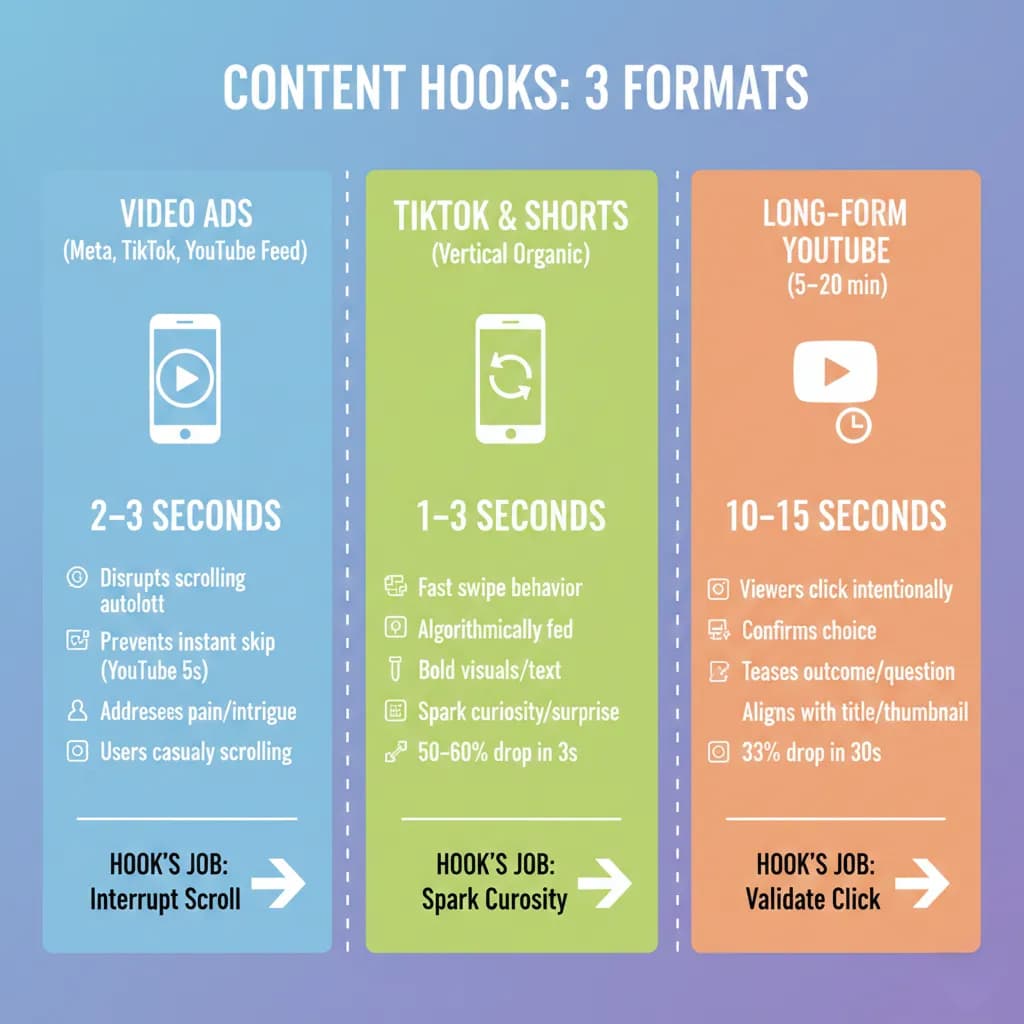
Hooks by Format: While the concept is universal, hooks take different forms depending on the video format and platform:
-
Video Ads (Feed-Based Ads on Meta, TikTok, YouTube): In paid social ads, the hook is usually the first 2–3 seconds of the ad that stops the feed scroll. The goal is to disrupt the viewer’s scrolling autopilot and prevent instant skip (especially for YouTube in-stream ads, where viewers can skip after 5 seconds). These hooks often address a pain point or present something intriguing immediately, because in a cluttered feed your ad is competing with cat videos, memes, and friends’ posts. Key behavior: Users casually scrolling their feed, not actively seeking your content. Hook’s job: Interrupt that scroll.
-
TikTok & Shorts (Vertical Organic Short-Form): In TikTok videos, Instagram Reels, and YouTube Shorts, the hook might be even shorter – often within 1–3 seconds – due to fast swipe behavior. The content is algorithmically fed, so viewers decide almost instantly whether to watch or swipe away. Successful short-form hooks tend to use bold visuals or text instantly and create immediate intrigue. Key behavior: Swipe-happy users with fleeting attention. Hook’s job: Spark curiosity or surprise instantly to make them pause (e.g. a quick question on-screen or a flashy action). Data shows 50–60% of viewers who drop off a Short do so within the first 3 seconds, highlighting how crucial the very start is.
-
Long-Form YouTube Content (5–20 min videos): On YouTube, viewers often click a video intentionally (from search or recommendations), so they start slightly more invested. Here the “hook” is the intro or cold open of the video, perhaps up to 10–15 seconds. The hook’s role is to confirm the viewer’s choice and persuade them not to click away in those early moments. Often creators will tease an outcome or pose a compelling question in the opening, aligning with the video’s title/thumbnail promise. If the intro fails to engage, viewers leave – in fact over 33% of viewers drop off within the first 30 seconds if the intro isn’t engaging. Key behavior: Viewers actively chose the video but will leave if it doesn’t meet expectations fast. Hook’s job: Validate their click by hinting at the value or story to come (often by opening with a bold statement, question, or sneak peek).
Paid vs. Organic Hooks: There are important differences in how you approach hooks for paid advertising versus organic content:
-
Paid Ad Hooks (Meta, TikTok, YouTube Ads): These need to grab attention without feeling like obvious ads. Users don’t like feeling “sold to,” so effective ad hooks often mirror organic content styles (UGC-style clips, trending formats) to blend into the feed. They might immediately call out a problem or a target audience (e.g. “If you have bad back pain, watch this”), or use an arresting visual, so the viewer’s curiosity is piqued before they realize it’s an ad. Also, since every second costs money, ad hooks are extremely concise: the value proposition or intrigue is front-loaded by ~2 seconds. The core goal is to stop the scroll and hold attention long enough to deliver your message. The risk for ads is that if the hook feels like an ad or takes too long, viewers will scroll past or hit “Skip” – wasting your budget.
-
Organic Hooks (TikTok, Shorts, YouTube content): With organic videos, you’re often playing to the algorithm as much as the viewer. A strong hook improves watch time and completion, which tells the algorithm to show the content to more people. Organic hooks can sometimes be more playful or narrative since you’re not constrained by a need to immediately sell. For example, a YouTube vlogger might start with “I made a huge mistake…” as a storytelling hook – something that builds intrigue for subscribers and casual viewers alike. The difference is organic viewers might give a few extra seconds of grace if they trust the creator or are intrigued by the title. However, the fundamental hook principles still apply: even organically, you need to hook fast or you’ll lose the audience to the infinite feed.
Feed-Scroll vs. Search/Intent Viewing: In feed environments (TikTok feed, Instagram/Facebook feed, YouTube Shorts feed), users are in distraction mode – they scroll endlessly, giving each piece of content only ~1–2 seconds to impress them. Hooks here must operate like pattern interrupts, visually or contextually breaking the monotony to force a pause. By contrast, in long-form YouTube (where a viewer clicked a specific video), there’s a tad more intent. The hook can leverage that by referring to the video’s promised topic (“In this video, I’ll show you…”) or by setting up an open loop that promises a payoff later. However, long-form hooks must still contend with short attention spans: YouTube’s algorithm strongly favors videos that maintain a high percentage of viewers in the opening seconds. Feed-scroll hooks focus on disruption and immediate relevance, whereas long-form hooks focus on establishing interest and aligning with expectations.
Format Comparison Table: Hook Differences
To summarize, here’s a comparison of hook approaches across formats:
| Format | Typical Hook Duration | Core Goal of Hook | Key Risk if Weak |
|---|---|---|---|
| Feed Video Ad (FB/IG, TikTok Ads, YouTube in-stream) | ~2–3 seconds (must immediately stop scroll) | Interrupt scrolling with a bold cue; promise quick value relevant to the target audience. Often text + visual that works with sound off. | Being skipped or ignored as “just another ad.” If it feels too salesy or is unclear, viewers swipe past in ~1.7 seconds on mobile, wasting ad spend. |
| Organic Short-Form (TikTok, Reels, YouTube Shorts) | 1–3 seconds (the swipe moment) | Spark intrigue or deliver a “wow” instantly – via a curiosity statement, flashy action, or shock fact – to make viewers pause. | Blend into the feed and get swiped. A hook that’s slow to reveal or generic leads to ~50% of viewers dropping in 3 seconds, so the video won’t get algorithm push. |
| Long-Form YouTube (5–20 min video) | 5–15 seconds (intro/cold open) | Give viewers a reason to keep watching: present a compelling question, outcome or preview of what’s coming. Confirm the title’s promise and create curiosity or stakes for the full video. | High early drop-off, hurting retention. A weak intro (e.g. “Hi, welcome to my channel…”) makes ~50% leave in 30s. The video will perform poorly in search/algorithm if viewers bounce early. |
Feed vs. Longform – Paid vs. Organic Recap: In essence, paid feed hooks are about disruption and relevance (“Stop scrolling – here’s something you need!”) to a cold audience, organic short hooks are about intrigue and pattern interrupts to earn watch time from a casual audience, and YouTube longform hooks are about setting up a story or value quickly to justify the click to an audience actively looking for content. Each scenario demands a tailored hook strategy, but all share one rule: grab attention FAST or lose the viewer.
2. Attention Psychology of Hooks
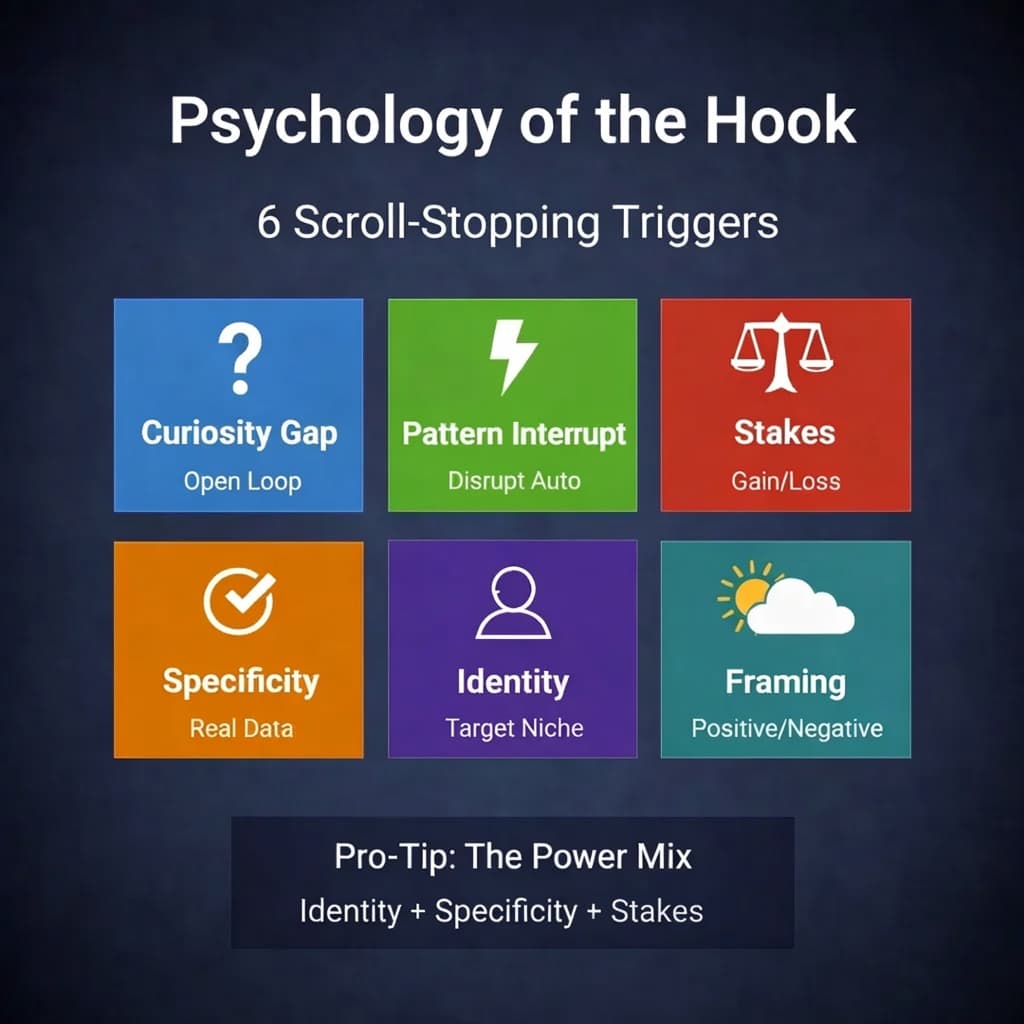
Crafting a great hook is as much a psychology exercise as it is a creative one. In those first moments, several cognitive and emotional triggers determine whether someone continues watching. Let’s break down key mechanisms – curiosity gaps, pattern interrupts, stakes, specificity, identity cues, and framing – and how they influence viewer behavior:
-
Curiosity Gap: Humans have a natural desire to close information gaps. A curiosity gap hook teases information or a story outcome without giving it away, making the viewer uncomfortable not knowing. This compels them to stick around until their curiosity is satisfied. Definition: Withhold a key piece of information or outcome to create an open loop. Works Best When: The topic is relevant and the payoff matters to the audience. For example, “There’s one thing in your bathroom that expires faster than you think…” – this opens a loop (what thing is it?) that viewers will want to close. Backfire Potential: If the payoff doesn’t come or isn’t interesting, viewers feel tricked (classic clickbait disappointment). Overusing curiosity without substance can erode trust. Real Example: “What no one tells you about creating videos for marketing…” – This hook from a marketing expert promises insider knowledge. It works by suggesting there’s a secret the viewer isn’t aware of, triggering curiosity. It could backfire if the video just provides generic tips (failing to actually reveal something new).
-
Pattern Interrupt: Our brains fall into rhythmic expectations when scrolling through similar content. A pattern interrupt breaks that expected pattern with something novel or odd. It could be a sudden movement, an unusual opening line, a surprising sound, or even a moment of silence – anything that stands out from the last 20 pieces of content the person saw. Definition: A jarring or unexpected element at the start that disrupts the viewer’s autopilot. Works Best When: Viewers are numbed by homogeneous content – e.g., many TikToks start to feel the same, so doing something different in the first second (a weird camera angle, an upside-down shot, a person in a costume) resets attention. Backfire Potential: If the pattern break is too confusing or off-putting and not tied to the video’s purpose, viewers might feel alienated (“What is this?”) and scroll. You must pivot quickly from the interrupt to your actual story or value, or you risk losing them. Real Example: A famous pattern-interrupt hook on YouTube Shorts: one creator opens every video with 0.3 seconds of their end result before cutting back to the beginning – a flash-forward that makes viewers go “wait, what was that?”. This visual interrupt, combined with a rapid cut, hooks by sheer surprise and then transitions into the content.
-
Stakes (Gain/Loss): People pay attention when something important is at stake – whether it’s a potential gain or a looming loss. Hooks that emphasize stakes leverage either fear of loss or promise of gain to trigger an emotional response. Definition: Presenting consequences or rewards upfront to make viewers care. This can be framed positively (“achieve X benefit”) or negatively (“avoid X problem”). Works Best When: The stakes are relatable and significant to the audience. Fear-based hooks tap into loss aversion – e.g., “If you don’t update this phone setting, you’re draining your battery” (the risk of loss motivates action). Gain-based hooks tap into aspiration – e.g., “This strategy could earn you an extra $1,000 a month.” Backfire Potential: Overdoing negative framing can feel like scare tactics and may turn people off if they don’t trust the source. Overpromising positive outcomes (“Make $1M overnight!”) triggers skepticism. Also, some platforms might flag extreme fear-based language as clickbait. Real Example: “Stop using these intros in your videos if you want to grow.” – This urgent warning hook combines a loss (stunting your growth) with a goal (you want to grow). It works by implying the viewer stands to lose progress if they continue a bad practice. A positive flip side example: “Increase your watch time by 50% with this editing trick.” – Here the stake is a big gain (50% improvement), which grabs those who want that benefit. Both rely on the viewer caring about the outcome (growth or improvement).
-
Specificity & Credibility: Vague hooks often fail because they don’t give the brain enough to latch onto. Specific details – numbers, names, concrete claims – make hooks more credible and intriguing. Definition: Using precise facts or clear promises in the hook to increase believability and interest. Specificity also signals expertise. Works Best When: Trust is a factor or the audience might be skeptical. Including a statistic, for instance, can make a hook compelling (“80% of people do X wrong…”). Or naming a very specific scenario: “Your keyboard is dirtier than a toilet seat. Here’s how to clean it.” – the oddly specific comparison feels credible (it’s presumably a real fact) and shocks the viewer, prompting them to keep watching for context. Backfire Potential: Specificity can backfire if the specific claim is unbelievable or if you can’t substantiate it. If a hook cites a statistic or bold claim and then the content doesn’t support it, viewers feel misled. Also, too much jargon or overly technical specifics can alienate a general audience – balance clarity with detail. Real Example: “This 5-second edit doubled my watch time.” – This hook (with a number and outcome) is specific and credible: it promises a concrete metric (doubled watch time) from a short action. Viewers interested in improving watch time will find this credible (because it’s a clear outcome) and will watch to learn the edit trick. On the other hand, a weak version of this hook would be “This edit improved my channel” (too vague – likely to be ignored). By being specific (“5-second edit” and “doubled my watch time”), the hook stands out and builds trust that the video will deliver a real tip.
-
Identity-Based Hooks: People are drawn to content that speaks directly to them or their identity. An identity-based hook explicitly calls out a group or persona, making those viewers feel seen. Definition: Leading with an audience identifier or relatable role so the target viewers self-identify and pay attention. For example, “Attention new moms struggling with sleep…” or “As a beginner programmer, you might be making this mistake.” Works Best When: You can accurately pinpoint a significant segment of your audience and their core traits or problems. It’s especially powerful for niche content or when you want to qualify viewers quickly. When someone hears exactly their situation, they perk up: “Do you batch-create content but struggle with consistency?” – a question that will hook content creators experiencing that problem. Backfire Potential: If misused, you might alienate those not in the group (“This isn’t for me” – and they scroll). Also, if the viewer doesn’t identify with the label you used or feels called out in a negative way, it can repel them. It works best when the identity is relevant and framed positively or empathetically. Real Example: “If you have ADHD, this app will change how you manage your day.” – This TikTok ad hook explicitly targets viewers with ADHD. For those individuals, this line immediately grabs attention (it’s about them). It works by promising a solution tailored to their identity (ADHD struggles). Viewers without ADHD might scroll past, but that’s fine because the hook efficiently zeroes in on the intended audience. Another example: “Calling all marketers: you’re ignoring this trend at your own risk.” – This kind of hook directly flags the identity (marketers), boosting interest among that group (and filtering out those who aren’t marketers).
-
Positive vs. Negative Framing: How you frame the hook – as a potential gain or a potential loss – can drastically change its impact. Positive hooks highlight benefits, opportunities, or good outcomes (“Achieve your dream results in 7 days!”), whereas negative hooks highlight problems, threats, or what the viewer could lose (“Don’t let this opportunity slip away”). When to Use Positive: If your content is aspirational or your audience responds better to encouragement. Positive framing can inspire and motivate (e.g., “Grow your savings with this simple trick”). It works best when the audience is optimistic or seeking improvements. When to Use Negative: If urgency or pain-points are strong drivers for your topic. Negative framing (when done carefully) taps into fear of missing out or avoiding pain. For example, “Don’t do X – you could be harming your results” creates a sense of risk that viewers want to avoid. Backfire Potential: Negative framing can come across as scaremongering or demotivating if overused. Viewers might resent overly negative hooks if they feel manipulated by fear. Some platforms (and viewers) also dislike blatant clickbait like “This will be the worst mistake of your life...” unless it’s truly justified. Positive framing can backfire if it sounds too good to be true or if it’s overly generic (“Improve your life instantly!” offers no hook). Often, a blend works well: state a negative to hook interest, then promise a positive resolution (“Don’t do X... do this instead to get Y”). Real Example: A negative-framed hook: “Most people are wasting money on skincare by doing this wrong.” – This grabs attention by implying the viewer likely has a problem (wasting money). It’s effective because it triggers avoidance motivation (I don’t want to be “most people” making this mistake). A positive-framed counterpart might be: “Here’s how to save money on skincare and get better results.” – which promises a benefit. Both can work, but they set different tones. Often, negative hooks earn the click/watch, and positive content delivers the payoff, ensuring the viewer feels it was worthwhile rather than just doom and gloom.
Understanding these psychological levers helps you decide what kind of hook to use for a given video. For instance, if you’re making a TikTok about a surprising life hack, lean into the curiosity gap (“Nobody is talking about this one hack for clean sinks…”). If you’re running a retargeting ad for a product, you might use specificity and stakes (“Still considering [Product]? Prices go up tomorrow – don’t miss out.”). The best hooks often combine elements: e.g. a specific curiosity gap + stakes: “There’s one setting draining your phone battery – and not changing it could cost you 20% of your charge.” This mixes curiosity (what setting?) with stakes (loss of battery life), and it’s specific. Always ask: What emotion or question am I igniting in the viewer’s mind? A great hook either makes them curious, concerned, or excited (or all three), and that’s why they can’t look away.
3. Taxonomy of 50+ Hook Types
Not all hooks are created equal – in fact, there are dozens of distinct “hook formulas” or types you can employ. Below is a structured taxonomy of hook types (50+ in total) grouped into broader categories. For each type, we’ll cover a description, best formats, any risks, and give real examples (in English) along with how the hook might look visually:
A. Problem-First Hooks
Description: These hooks open by immediately naming a problem or pain point the target audience is experiencing. The classic formula is “Tired of X problem? …” or “If you struggle with Y, [keep watching]”. By leading with the viewer’s pain, you establish relevance in seconds. The viewer thinks, “Yes, I do have that problem,” and is hooked to see the solution.
-
Applicable Formats: Highly effective in ads (where you need to qualify the right viewers quickly) and short-form videos targeting specific frustrations (fitness, tech issues, etc.). Also works in long-form YouTube intros for tutorial or how-to videos (e.g., “Struggling with camera focus? Let’s fix it”).
-
Risks: If the problem is too general, it won’t feel personal enough and viewers may ignore it. If it’s too specific or the viewer doesn’t have that problem, they’ll scroll past – but that’s an acceptable risk if targeting is good (you’d rather hook the right audience and let others go). Also, avoid sounding infomercial-y with clichés (“Do you suffer from…?” in an overly salesy tone). Authentic phrasing works better (“Tired of blank?”).
-
Examples:
-
“Tired of your makeup melting off by noon? Try this.” – Opening with a relatable frustration for the beauty audience. Visually, this might start with a close-up of someone’s face midday, makeup smudged, wiping sweat (instantly conveying the problem), with on-screen text “Tired of your makeup melting by noon?” This immediately hooks anyone who’s experienced that annoyance.
-
“If your Reels flop after 200 views, this is why.” – Calls out a specific scenario creators face. The hook zeroes in on the pain of plateaued views. Visually: could show a phone screen with a stuck view count, and the creator looking frustrated. It promises an explanation, hooking those who have felt that creator pain.
-
“Can’t keep your apartment smelling fresh with pets around?” – Another problem-first hook (for a cleaning product, for instance). This specifically addresses pet owners’ common issue. A visual could be someone sniffing and making a face in a room, with a pet in frame, plus caption text highlighting the problem.
-
Visual Style: Show the problem in action. If it’s a physical issue, depict it (messy room, dead houseplant, laggy phone, etc.). Use text overlays that name the problem in the viewer’s own words (“Leggings rolling down during workouts?” over footage of someone pulling up their leggings). The key is to make the viewer feel seen – that moment of “ugh, yes that happens to me!” serves as the hook.
B. Outcome-First Hooks
Description: These hooks flip to the result or outcome first – showing or stating the desirable end-state to capture attention. It’s the “promise” up front. For example, “Grow tomatoes twice as fast with this trick” or visually showing the amazing after before explaining. Outcome-first hooks appeal to the viewer’s aspirations by dangling the reward immediately. They often answer the viewer’s question “What’s in it for me?” within seconds.
-
Applicable Formats: Great for tutorials, case studies, and any content where the payoff is compelling. In long-form YouTube, this might be a cold open showing the end result (e.g., a final art piece) before the process, to hook interest. In ads and short videos, stating a big result can stop scrollers (people love quick wins and transformations).
-
Risks: If the outcome seems too unbelievable (“I lost 50 lbs in 2 days”) it will be dismissed as nonsense or clickbait. The outcome must be credible and ideally you’ll hint at how it’s achieved so it doesn’t feel like pure hype. Additionally, showing the result first can spoil the suspense if overdone – ensure there’s still a reason to watch (e.g., how you got there).
-
Examples:
-
“We got 1,000 sign-ups for our conference with zero ads. Here’s what we did instead.” – This YouTube hook presents a stellar outcome (1000 signups) and a twist (without ads). It’s outcome-first with a contrarian angle. Viewers interested in marketing results are hooked by the success metric and curious about the unconventional method. Visual: could start with footage of a packed conference or a graph of sign-ups skyrocketing, with text “1000 sign-ups, $0 on ads” – a snapshot of the achievement to make people say “Wow, how?”.
-
“Speak fluent Spanish in 30 days – here’s how.” – A bold outcome (fluency in 30 days) stated upfront. If this leads an ad or short video for a language app, it immediately promises the result the audience wants. The hook would need to quickly build credibility (maybe mentioning a method or proof) to avoid skepticism, but it’s powerful. Possibly accompanied by a clip of someone confidently speaking Spanish after 30 days of practice, to visualize the outcome.
-
Visual-first variant: A TikTok shows a messy, cluttered room that transforms into an organized space in 1 second via a smash cut – essentially showing the “after” result instantly. Then the text: “How did we go from THIS to THAT in 5 minutes? Keep watching.” This is an outcome (clean room) presented first as a hook, relying on visual shock value.
-
Visual Style: Highlight the reward immediately. If it’s a physical transformation, flash the before/after. If it’s a statistic or achievement, put that number in big text on screen (“$10,000 in sales on day 1” or “Battery +50% life”). Outcome hooks often use superlatives (fastest, easiest, best) or specific outcomes (“doubled my CTR”, “lost 20 lbs”, “mastered a skill”). Just ensure to quickly follow up with context so it’s believable. The tone is “Look what’s possible!” to get viewers excited about learning how to get there.
C. Contrarian Hooks
Description: Contrarian hooks challenge a common belief or flip conventional wisdom on its head. They often have a spicy, “Everyone says X, but they’re wrong – Y is true” vibe. By being contrarian, you spark intrigue because people love controversy or new perspectives. These hooks position you as an authority who knows better than the status quo, and viewers stick around to hear the justification or explanation.
-
Applicable Formats: Excellent for thought leadership content, expert analyses, and ads targeting savvy consumers. On LinkedIn or B2B content, a contrarian statement can provoke discussion (“Stop doing brainstorming sessions!” in a productivity video, for example). On YouTube, titles and hooks like “You’ve been cooking pasta wrong” or “Why everything you learned about SEO is a lie” do well to pull in a curious crowd. In ads, a softer contrarian approach can be “You don’t need [thing everyone thinks you need]” to make the viewer rethink assumptions (often used in weight loss or finance niches: “No, you don’t need a strict diet to lose weight…” etc.).
-
Risks: This hook walks a fine line. If it comes off as just contrarian for shock value without substance, it can seem gimmicky. Also, you may alienate some viewers who feel attacked or defensive about the conventional practice you’re debunking. You should be prepared to back up the contrarian claim with evidence or a strong argument, otherwise you lose credibility fast. There’s also a minor risk of attracting haters/trolls who just want to argue – which isn’t terrible for engagement, but something to be mindful of.
-
Examples:
-
“Most creators think consistency is key… but I grew by posting less*.”* – Implies that the standard advice (“post consistently”) might be wrong or at least not the full story. This hooks other creators/content marketers who have heard the consistency mantra; they’ll watch to see why posting less could actually be more effective. It’s contrarian and promises an interesting insight.
-
“You’ve been brushing your teeth wrong your whole life.” – A hook often seen in viral life-hack or health videos. It boldly states that a common routine is wrong. The viewer’s reaction is “Wait, what? How can something so basic be wrong?”. Curiosity piqued – they want to know the “right” way or what the catch is. Such hooks do extremely well in short-form (Reels/TikToks) because of the shock factor combined with self-interest (everyone brushes their teeth; no one wants to do it “wrong”).
-
“No, you don’t need a huge following to sell online.” – A contrarian hook for maybe a B2B or entrepreneurial context. The common belief = you need a lot of followers to succeed in e-commerce. This hook flatly says “No, that’s a myth.” It grabs aspiring entrepreneurs or small business owners, encouraging them that conventional social metrics aren’t everything. They’ll listen to hear why and what to do instead.
-
Visual Style: Emphasize the “negation” or the unexpected element. One approach is text that literally says “Stop [common practice]” or “Myth: [common belief]” followed by “Fact: [your contrarian point]” to quickly frame the dispute. For example, on-screen: “❌ Stop Posting Daily” then a cut to the speaker saying, “I grew faster when I stopped posting every day.” This combines a pattern interrupt (someone telling you to stop what everyone says to do) with contrarian content. Visually, the creator might shake their finger “no” or show a popular practice and cross it out. High contrast or shock imagery can underline the challenge (e.g., pouring soda into a plant if the myth is “plants love soda” – something visually contradictory). The key is the hook line itself which must clearly oppose a norm to intrigue viewers.
D. Specific Claim Hooks
Description: These hooks make a very specific claim or statement that grabs attention. They often involve surprising facts, statistics, or highly specific scenarios. The specificity acts as a hook because it stands out from vague general content – it feels concrete and often unbelievable yet plausible, prompting the viewer to want more context. Many viral hooks fall under this: “Your keyboard is dirtier than a toilet seat”, “Humans share 50% of their DNA with bananas,” or “This tiny country has more lakes than the rest of the world combined.” They sound like trivia or revelations that beg an explanation.
-
Applicable Formats: Short-form videos love surprising factoids, so this type thrives on TikTok/Reels/Shorts (“Did you know…?” hooks). It’s also great for the opening of listicle videos or educational content on YouTube (“Top 10 unbelievable facts…”). In ads, a specific shocking claim about the product or problem can stop people (“This AI tool saved me 10 hours a week on emails”). It’s also common in headline-style hooks for blog-like content or newsy videos.
-
Risks: The claim needs to be accurate (or at least addressed honestly) – if you throw a stat or fact that’s false or misleading and don’t clarify it, you risk trust. Also, some viewers might scroll past if the fact alone doesn’t personally concern them (so ideally tie it back to why they should care). Another risk: if the fact is too complex, it might confuse instead of hook – keep it digestible. And avoid overly niche specifics unless targeting a niche; for broad audiences, the fact should have broad “huh, interesting!” appeal.
-
Examples:
-
“Your keyboard is dirtier than a toilet seat. Here’s the fastest way to clean it.” – This hook (which has been used in ads/content) leverages a gross-but-specific fact. It catches attention because it compares two unexpected things (keyboard vs toilet seat hygiene) and promises a solution (fast way to clean). It’s specific, credible (likely sourced from somewhere), and directly relevant to any computer user (which is a lot of people). As a video hook, the creator might start by zooming into a keyboard and a toilet with a shocked expression, text stating that fact, then quickly moving into a keyboard cleaning demo. Viewers stick around out of sheer “eww, really? I need to see this” curiosity.
-
“95% of businesses still haven’t figured this out…” – A claim hook geared at a business audience. It uses a statistic (which may or may not be exact, but the point is it feels data-driven) to say most people are missing something. The natural impulse is “What is it that 95% missed? I don’t want to be in that 95%.” It’s specific in using a number and sets up an info gap that demands filling.
-
“The average person wastes 40 hours a year looking for lost photos.” – This type of oddly specific stat (which could be used to hook for a cloud storage app or phone organization tip) jolts the viewer because it quantifies a mundane annoyance in a striking way. If you hear that in a hook, you might think, “I do spend too long scrolling my camera roll… 40 hours? No way – how do I avoid that?” and you’re hooked to learn the solution (maybe an app or hack being promoted).
-
Visual Style: If possible, display the number or key claim text prominently – big, bold on-screen text for the stat or claim helps it land (e.g., “80%” or “40 hours” in huge font). Pair it with visuals that illustrate the claim: for the keyboard example, maybe an image of a toilet seat vs a keyboard with germ graphics. For a stat about time wasted, show a clock spinning or a frustrated person searching their phone. Creators often start with “Did you know…?” as a text or voiceover prompt, which signals a fact is coming. The hook should quickly follow with the surprising detail. Because specific-claim hooks tend to have a factual tone, conveying authority helps – a confident voiceover or using captioning to ensure it’s read even on mute (especially for feed platforms). The visual/aural combination essentially presents a mini “news flash” to the viewer, leveraging their curiosity about the world.
E. Story & Cold Open Hooks
Description: Humans are wired for storytelling. A story hook drops the viewer into the middle of a story or an emotionally engaging situation without preamble. Often called a cold open, it might start at a dramatic moment (“He looked down and saw sharks circling below him…”) or with a personal confession (“I have to admit – I never thought I’d share this…”). By opening in the middle of action or with a compelling narrative teaser, you create an urge to find out what happens next or why that situation happened. Story hooks rely on our inherent interest in unresolved narratives and human experiences.
-
Applicable Formats: Longer YouTube videos frequently use this (start with an exciting clip from later in the video, then restart from beginning). Vloggers and storytellers often use a one-line preview of a climactic moment. Short-form can also leverage micro-stories (“Mini story in three beats” hooks) – think TikToks that start with “So I did something crazy today…” or a POV scenario. In ads, a story hook can be very effective if it feels authentic – e.g., user-generated style ads where someone starts with “I’ll be honest, I wasted $5k on bad ads before I tried this…” (a confession leading into the product solution). This category includes confessionals, anecdotes, “once upon a time” openings – anything narrative.
-
Risks: Story hooks need to be tight. If you start a story but take too long to get to the point, viewers might not stick around (the hook fails if it drags). You also need to ensure the story is relevant to the content or product – a random story might hook initially, but if it feels disconnected from the video’s value, viewers will drop off when they realize it’s not what they expected. Additionally, a highly personal or niche story might not resonate with everyone; often it helps to frame it so that the audience can see themselves or at least get intrigued (“I almost died doing this…” is broadly intriguing, whereas “I had coffee at 8am” is not).
-
Examples:
-
“I wasted $10K on ads before realizing this.” – A strong confession style story hook. This works on multiple levels: it’s contrarian to expectation (people usually brag about success, not failure), it’s specific ($10K wasted grabs attention), and it promises a story of lesson learned (what “this” did they realize?). Intended audience (marketers, business owners) will want to hear the story to avoid the same mistake. Visually, this could be a person talking directly to camera with a candid, frustrated expression, maybe holding their head in their hand – conveying regret and sincerity, with caption text of that confession line to pull you in.
-
“Day 1: I had zero experience. Day 30: 100,000 subscribers.” – A timeline story hook. This format “Day X… Day Y…” immediately outlines a story of transformation. It hooks viewers by fast-forwarding from a starting point to an impressive ending, implying there’s a journey to discover. You see this often in challenge videos or journey vlogs (fitness transformations, month-long challenges, etc.). It combines story with outcome – and viewers stick around to see the in-between story of how that happened. On screen, one might show a clip from Day 1 (maybe a shy introduction) vs Day 30 (celebration screenshot of 100k subs), then go back to narrate how each day progressed.
-
“My hands were shaking as I cut the blue wire… and then…” – A dramatic cold-open for a story (perhaps fictional or a dramatic retelling). It places the viewer at a tense moment (cutting a blue wire – sounds like a bomb defusal scenario) with no context. That naturally triggers what led to this? and what happened after?. You’d then likely rewind and narrate how you got there. This works for storytelling channels or any content where you can isolate a peak moment to tease at the start (similar to how some TV shows cold open on an intense scene, then go “36 hours earlier…”).
-
Visual Style: Start in medias res – i.e., right in the middle of things. If it’s a vlog or personal story, maybe the very first shot is shaky cam footage of you in the climax of the story (“...then the bear charged at me” with you breathing heavy in the woods). For confessions, a close, intimate framing with direct eye contact works, maybe with a slightly hushed tone that signals, “I’m about to tell a story.” Text subtitles can help ensure the hook line (especially if it’s one juicy sentence) is delivered even if sound is off. Some creators put a very short cinematic clip or sound at the start – e.g. a half-second of a shocking moment – as a pattern interrupt combined with story (like a smash cut to the dramatic moment, then back to the beginning of the narrative). Emojis or visual aids can also emphasize the emotion (😱 or 🤦♀️ in captions to highlight shock or facepalm moment). Key: the first line or image should immediately present a scenario or conflict – something must clearly be happening so viewers get pulled into the narrative instantly.
F. Proof/Authority Hooks
Description: These hooks establish credibility or proof upfront to assure viewers that what follows is worth their time. They often leverage social proof, expert status, or demonstrations of authority. Essentially, they hook by saying “Trust me, this is valid and important.” This can be done by citing credentials (“As a NASA scientist, I…”), showing impressive social proof (“This formula got me a 98% success rate”), or even starting with a quick testimonial or before-after demonstration that acts as proof of concept. By seeing proof first, viewers become interested and confident that continuing to watch will be valuable.
-
Applicable Formats: Ads for products use this often (a hook showing a customer’s genuine reaction or a one-line testimonial: “This thing actually worked!” to build immediate trust). Expert YouTube videos might start with a quick flash of results or an accolade (“We helped 1000 students ace the SAT – here’s how”). In B2B or educational content, beginning with a data point or case study result can hook more skeptical audiences. Even short TikToks can use authority: e.g. text like “Doctor explains why you’re always tired” – the word “Doctor” lends authority that hooks interest.
-
Risks: If overdone, it can sound boastful or like an ad (“#1 best-selling author reveals…” might cause eye-rolls if not done carefully). It’s important to still provide value in the hook, not just flex credentials. Also, ensure the authority is relevant to the audience – bragging about something they don’t care about won’t hook them. Another risk is boring the viewer – if you just say “In a study by X University…” it might come across as dull unless framed in a compelling way. Proof hooks work best when tied to a promise: “Here’s proof, therefore stick around for the solution/insight.”
-
Examples:
-
“I didn’t expect this to actually fix my back pain.” – This is an actual quote from a user that could serve as a hook in an ad (for, say, a posture corrector or a therapy method). It’s essentially social proof delivered as a hook: a real user expressing surprise that something worked. This hooks viewers (especially those with back pain) because it implies: someone like them got relief after skepticism. Visually, you might show that person using the product and smiling in relief while that quote appears in text or voiceover. It feels authentic, drawing people in with trust.
-
“Stanford engineers created this device to triple Wi-Fi speed.” – A hook that leverages authority (Stanford engineers) and a specific claim (triple Wi-Fi speed). For a tech gadget ad or video, this establishes immediate credibility (it’s not some random hack, it’s developed by experts) and an impressive benefit. The combination is a strong hook for tech enthusiasts. The viewer thinks, if Stanford engineers are behind it, there’s real science here – I should watch.
-
Quick demo as proof: Imagine a TikTok starts with 2 seconds split-screen: left shows a person covered in pet hair, struggling with tape; right shows the same person quickly rolling a new gadget over their shirt and all hair is gone. Text: “One roll – all pet hair gone.” This visual proof acts as a hook. It’s essentially “demonstration first, explanation later.” Viewers who also battle pet hair are hooked by seeing something work in front of their eyes in seconds. This is common in cleaning and gadget niches – show the result or the thing in action successfully as the hook (a kind of proof that “yes, this delivers”), then backtrack to how/why.
-
Visual Style: Two approaches: direct credibility cues or instant demonstration. For credibility, you might show something like a trophy, badge, or text overlay “Award-winning chef” or “PhD Researcher explains…” to signal authority. Quick cuts of headlines or logos (“Featured in Forbes, TechCrunch”) can also establish external validation early on. This needs to happen fast – think a 1-second montage of “As seen on [Logo]”. Keep it brief enough to not lose momentum. For demonstration-as-proof, use a compelling before-and-after or real-time result as the very first thing viewers see (the classic “Don’t tell it, show it”). UGC-style proof hooks often just start mid-testimonial: a real person on selfie camera saying “Guys, I tried everything for my acne and this is the only thing that worked –” (authentic, shaky cam, real voice). That authenticity can hook viewers better than a polished intro because it feels like raw proof from a peer. If you have numbers as proof (e.g., “100,000 users” or “98% success”), flash them on screen or say them confidently in the first sentence. The design is to front-load credibility so the viewer subconsciously thinks, “Alright, this seems legit, I’ll give it a chance.”
G. Curiosity Loop Hooks
(Note: We touched on Curiosity Gap in psychology, but here we’ll outline some specific types of curiosity hooks as part of taxonomy.)
Description: These hooks create a curiosity loop – posing a question or scenario that the viewer can’t resolve without watching the video. They often end the hook on a cliffhanger. It’s similar to curiosity gap but more structured: think of it as explicitly saying, “I’m going to tell you something intriguing… but not yet.” Many effective hook lines are actually questions or teasers that force the viewer to mentally ask “Why? How? What’s next?” and then stick around for the answer.
-
Applicable Formats: YouTube titles and intros heavily use this (“What if I told you your diet soda is making you gain weight?”). Shorts/Reels use questions as hooks a lot (“Ever wonder why TikTok videos use captions?”). Ads can use this by posing a question that aligns with the product’s solution (“What if your phone could charge itself?”). Anywhere you can present a riddle, mystery, or intriguing question at the start, a curiosity loop can form. Tutorial and educational content also love open loops (“By the end, you’ll learn the secret to X, but first…” – though you have to be careful not to drag too long).
-
Risks: If the hook is too vague or appears like empty clickbait (“This trick will change your life…”) without context, some viewers may dismiss it. You need to strike a balance: tease enough detail to sound interesting, not so little that it’s meaningless. And crucially, close the loop later – if you raise a question and never answer it clearly, your audience will be annoyed (and feel tricked). Another risk is posing a question the viewer isn’t interested in; make sure it’s relevant. Also avoid overly formulaic “You won’t believe…” phrasing which audiences have learned to distrust unless followed by something substantive.
-
Examples:
-
“There’s one ingredient in your kitchen that’s ruining your coffee.” – A curiosity hook that implies a mystery: one common ingredient (but which?) is the culprit. Coffee drinkers will be hooked because they’ll want to know what they might be doing wrong every morning. It’s an open loop: we know the scenario (kitchen ingredient in coffee), we know the outcome (it’s ruining the coffee), but we don’t know the specific ingredient – that’s the loop that needs closing. Visually, this could start with someone about to put something in coffee, then a big “X” overlay or a question mark on screen, and the line delivered in text or VO. Viewers will stick around hoping the video will reveal the ingredient and what to do instead.
-
“What happens if you never turn your phone off?” – A direct question hook. It takes a fairly mundane concept (many of us leave our phones on 24/7) and makes it intriguing by asking what the consequences are. The viewer is prompted to think, “Hmm, I actually don’t know. Will it break? Slow down? Is this a tech tip I need?” Such a hook works well for a tech explainer video or a TikTok from a phone repair expert. The question itself is the hook, creating a curiosity loop that the video will presumably close by explaining the answer.
-
“I opened my old laptop and you won’t believe what I found…” – A narrative curiosity hook. It sets up a scenario (opened old laptop) and teases a discovery but withholds it. The phrasing “you won’t believe what I found” is a bit cliché but still effective if the payoff is actually interesting. People will watch to see the reveal (perhaps bugs inside, or a stack of cash in the CD drive – who knows?). The key is that the story is paused at the juiciest moment (the discovery) and the viewer must keep watching to satisfy the curiosity of what it was.
-
Visual Style: Many curiosity hooks lean on text overlays of the question or teaser because questions naturally catch the eye (especially with a question mark punctuation visible). For example, starting a video with large text “What if the Moon disappeared?” while showing a quick animation of the moon vanishing can hook science lovers – the question is right there and visualized. Using ellipses “…” in captions or cuts can imply an unfinished thought, reinforcing the open loop. Also, pacing is important: often a curiosity hook might be a two-part sentence where the cut or dramatic pause happens right at the cusp of the reveal. For instance, “This device might be spying on you right now, and… [cut to next clip] …most people have no idea.” The initial clip ends on an and... to roll the curiosity over. Also, combining curiosity with identity or specificity can strengthen it (e.g., “Ever wonder why your TikTok views die at 40% watch time?” – that’s targeted curiosity). Using a question directed to the viewer (second person “you”) increases engagement because it feels like part of a conversation in their head. The key visually and textually is to dangle the carrot: show just enough to entice, then promise the explanation or answer if they stick around.
H. Challenge/Test Hooks
Description: These hooks introduce a challenge, test, or experiment right at the start to pique interest. Often phrased as “We’re going to test X vs Y” or “I challenged myself to do X”, these hooks work by engaging the viewer in a kind of curiosity + stakes combo: there’s a clear task set out and we want to see the result. Challenges naturally create a narrative (will it be a success or failure?) and viewers stick around for the outcome. It also invites the viewer to mentally participate (“What would I do? Who will win?”).
-
Applicable Formats: Extremely popular in YouTube challenges and MrBeast-style videos (“I stayed 50 hours in a coffin”), also common in TikTok (24-hour challenges, social experiments). Ads can use mini-challenges like “We put the two top stain removers head-to-head – watch which one actually works” as a hook (engages by promising an unbiased test). Any scenario where you can pit two things against each other or attempt something difficult/unusual works. Live demos in ads often take the form of a “Let’s test this” hook to show the product in action.
-
Risks: If the challenge isn’t interesting or relevant, it won’t hook (so choose compelling or extreme challenges). Also, a challenge hook sets an expectation that the video sticks to that challenge – veering off or under-delivering the result will disappoint viewers. There’s a slight risk of viewers skipping ahead to see the result (especially in long videos) – some creators mitigate this by adding intermediate curiosities or making the journey entertaining. In ads, doing a “versus” test can backfire if it looks obviously biased; it’s best executed in a fair-looking way.
-
Examples:
-
“We put two popular stain removers to the test – watch which one actually works.” – A hook used in an ad or content about cleaning. It clearly outlines a challenge: two products, one face-off. The viewer is hooked to see the experiment and the winner. It implies a visual demonstration (stain remover A vs B on identical stains) which adds to the interest. This kind of hook appeals because people love comparative tests when they have a stake (maybe they use one of the products, or they just enjoy the Mythbusters-esque approach).
-
“I tried waking up at 5 AM for 30 days – here’s what happened.” – A classic personal challenge hook. It presents a relatable yet challenging task (waking up 5 AM for a month) and teases that there’s an interesting outcome or lessons (“what happened”). Viewers who are curious about productivity or habit building are drawn in to see if this challenge made a big difference or if it was a fail. The hook promises a story arc (beginning difficulty, the process, and the result).
-
“$50 vs $500 Wine: Can we taste the difference?” – A comparison challenge hook. Two very different price points set up a test of expertise. It hooks by inviting the question of whether expensive equals better and if the testers (or by extension the audience) can tell. This works great in formats like BuzzFeed’s tests or any social video series. The viewer might have a guess and they’ll watch to see if they’re right, effectively playing along.
-
Visual Style: Show the elements of the challenge immediately. For the stain remover example, you might literally open with split-screen of the two products and the stained shirts, maybe a text “Product A vs Product B” on each side. For personal challenges, a day counter or progression montage at the very start (flashing “Day 1, Day 15, Day 30…” briefly) can hook because it suggests a journey. You can also visually display the stakes or question: e.g., for the wine test, show two unmarked glasses of wine and big “$50 vs $500” text. Sometimes adding a countdown or timer graphic can emphasize the challenge aspect (like a ticking clock or day count for a 30-day challenge). The language often includes “Challenge:” or “I did X challenge” explicitly in text or voice to frame it quickly. Energetic music or quick-cut editing can signal it’s a fun experiment. The hook should make viewers predict outcomes in their mind – you can even encourage this by posing it as a question: “$50 vs $500 wine – can you taste the difference?” thus directly pulling them in. The excitement of a challenge is seeing it unfold, so visually hint at the process too (maybe a 1-second supercut of some key moments of the test right after stating the challenge, to promise a payoff of fun or drama).
I. Visual-First Hooks
Description: These hooks rely primarily on a striking visual element out of the gate, rather than words or storyline. The idea is to show something so visually intriguing that the viewer is instantly captivated, even before any explanation. In a world where many people watch videos muted (especially in social feeds), visual-first hooks are powerful – they grab attention with motion, color, novelty, or satisfying imagery. Examples include: an unusual action (e.g. someone pouring 10,000 Skittles on a table), an eye-catching scene (a person in a dinosaur costume running through an office), a mesmerizing motion (slow-mo of ink dropping in water), or text animations that pop in a flashy way. Essentially, the picture says “watch me”.
-
Applicable Formats: TikTok and Reels heavily reward visual punches in the first second (since sound may be off, visuals carry the hook). Ads also often start with a dynamic visual (product in action, quick montage) to stop the scroll. YouTube intros can use a quick visual preview of something exciting later in the video as a cold open clip. Anytime you have something that looks fascinating – whether oddly satisfying, shocking, or just beautiful – putting it right upfront can serve as the hook.
-
Risks: Purely visual hooks can sometimes confuse if not contextualized soon after – the viewer might be like “Ok that looked cool, but what’s going on?” If it takes too long to explain or connect that visual to your content, they might lose interest. Also, if the rest of the video isn’t as visually engaging, there could be a drop-off after the initial scene. Essentially, ensure the visual relates to your content and that you follow up quickly with either text or voice to anchor it. Another risk is using irrelevant but attention-grabbing visuals (clickbait-y tactics) – that can lead to high early retention but then steep drop-off once people realize it was bait-and-switch (and can anger the algorithm or audience).
-
Examples:
-
A visually satisfying moment: The hook of a DIY craft video shows immediately a perfect resin pour with shimmering colors filling a mold, or paint being perfectly mixed – something satisfying to watch. This draws in viewers who love these satisfying visuals. For instance, the video might be about making a resin table; the hook is the mesmerizing swirl of resin as it’s poured (no words needed, maybe a close-up shot). People will keep watching because it’s pleasing and they anticipate seeing the final result.
-
Pattern-break visual: Imagine a TikTok starts with the creator hanging upside down from the ceiling while talking normally (camera flipped). Scrollers seeing this unusual scene are likely to stop simply out of “what the heck?” It’s an absurd visual hook. The content might be comedic or an intro to a point about seeing things from another perspective – but the initial hook was entirely visual (person upside-down). The viewer is hooked by sheer novelty and will listen to find out why the person is upside down.
-
Handwritten text animation: In an Instagram Reel, the first frames show a hand writing on the screen “3 things I wish I knew at 25 →” in a cool animated way. The motion of the handwriting draws the eye, and the text itself teases a list (which adds curiosity). This is a hybrid of visual and textual, but it’s the stylistic visual (handwritten, appearing live) that sets it apart from typical static text. Many people will stop to read it because it doesn’t look like a typical typed caption – it feels personal and dynamic, increasing engagement.
-
Visual Style: Key techniques include movement, color, and novelty. Quick camera movements (a sudden zoom, a whip-pan) can act as a pattern interrupt visually. Bright colors or high contrast in the first scene (a big splash of paint, a neon sign) can catch the eye when thumbnails are otherwise dull. Novelty could be props, costumes, or settings that are unexpected (someone in full costume in a grocery store will stop thumbs). Text as visual: large captions or dynamic subtitles timed with the first words can themselves be a visual hook – especially if styled creatively (big emojis, bold keywords popping up). Many TikToks now use big bold text in the first second to hook silent scrollers (e.g., “STOP ❗ You need to see this hack” in huge letters over the video). Also, leveraging silent storytelling: since many watch without sound, a visual hook might involve demonstrating something wordlessly (like showing a gadget doing something amazing in 2 seconds, which hooks even without needing audio explanation). Slow-motion or time-lapse can also be used as a visual hook – either something in extreme slow-mo (which looks instantly intriguing because it’s out of the ordinary), or a fast timelapse of a process that normally takes time (e.g., a 5-hour painting completed in 5 seconds at the start). Think of visual hooks as thumbnails in motion – what would make someone stop if it were a single thumbnail? Now amplify that with motion or change over a couple seconds. For example, a single thumbnail of a cake being cut is nice; a visual hook could be that cake exploding with filling as it’s cut, in video form. Always ask, if I were scrolling with sound off, would this visual make me stare? If yes, it’s a good visual-first hook.
J. UGC/Authentic Hooks (Confessions, POV, “Native” style)
Description: These hooks mimic user-generated content style – raw, unpolished, personal – or involve a tone of confession and authenticity. The idea is to immediately give the impression of “real person, real talk” as opposed to a polished presentation. This can be a direct selfie-camera confession (“Okay, I have a confession: I’ve been doing this wrong for years…”), a POV scenario that feels like a friend sharing a secret, or using platform-native features like comment reply bubbles to start (e.g., replying to a viewer’s comment as the hook). By starting in a UGC style, viewers feel like the content is organic and relatable, not an ad or staged bit, which can hook them through a sense of genuine connection or curiosity.
-
Applicable Formats: Obviously TikTok, Instagram Reels – platforms where native-looking content outperforms slick ads. Many brands deliberately create ad hooks that look like a casual TikTok (we call these “TikTok made me buy it” style hooks). Facebook/Instagram Story ads too often use a person talking to camera as if it’s their story. On YouTube, this might be less common for hook (since YT audiences expect higher production sometimes), but some creators open with a raw snippet (“I’m gonna be honest with you…”). For personal branding and storytelling, confessional hooks are gold – they humanize you instantly.
-
Risks: The content still has to deliver; being raw for raw’s sake isn’t enough. A boring confession or generic “hey guys” won’t hook – it needs to hint at something interesting (a mistake, a secret, etc.). Also, if it’s an ad disguised as UGC, be careful: savvy viewers sniff out inauthenticity. The hook might work to get attention, but if it immediately shifts into salesy tone, viewers drop. Consistency in authenticity is key. Additionally, a very shaky or low-quality visual might turn off some viewers who expect a baseline of clarity – so there’s a balance between authentic and just hard-to-watch.
-
Examples:
-
“I have a confession to make… I’ve been using [competitor] all wrong this whole time.” – Starting with “I have a confession” is a classic hook phrase that feels like someone being real and vulnerable. For instance, a marketer on LinkedIn might start a video or post with that to then explain a mistake they made. It works because people perk up at the word “confession” – it implies juicy honesty. In a video, this could be delivered selfie-style, a person sighing or looking nervous for a second and then admitting something. It’s UGC in tone and also uses curiosity (confession about what?) to hook.
-
TikTok comment reply: The very first frame shows a TikTok comment on screen (the native reply feature), like someone commented “Does this acne patch actually work?🤨” and the creator’s hook is them replying, “@User123 – let’s test it right now.”. This is hugely effective as a hook because it feels like a continuation of a conversation, and TikTok viewers recognize the format as native (not an ad). It’s UGC in that it leverages actual user interaction. Immediately, viewers are like, “Oh, this person is responding to someone, let’s see what they say.” It also sets up a little story/test (they’re going to show if the acne patch works) – double hook.
-
POV hook: A Reel might start with text “POV: You’re working late and…” while the creator acts out a relatable scene. For example, “POV: You’re the only one in the office at 9PM, and you hear a noise”. This pulls viewers in by making them feel like part of a mini story (relatable or humorous usually). It’s authentic in the sense of everyday scenario, and “POV” is a very native social media framing that signals a skit or scenario. People often stop because they identify with it or are curious how it plays out.
-
Visual Style: The mantra is “make it look like content, not an ad.” Selfie camera, imperfect lighting, direct eye contact, and a personable tone all help. Starting mid-sentence or with a candid vibe (“Okay so… listen.”) can hook because it feels like you caught someone in the middle of real talk. Using platform features like the TikTok comment reply bubble, green screen with a comment or duet/stitch format, or Instagram poll results as a prompt, all immediately signal this is native content. Subtitles can be stylistically the casual kind (auto-caption apps with emojis or lowercase text can impart a UGC feel). If it’s a confession or story, showing genuine emotion (a laugh, an eyeroll, a facepalm) in the first seconds makes it human and relatable. UGC hooks often break the fourth wall strongly – speaking to the viewer as if to a friend: “You’re not gonna believe what just happened to me.” The camera might be handheld (slightly shaky) to avoid that polished tripod look. Even mistakes or stumbles in speech (if natural) can work in your favor to sell authenticity. For brands, sometimes deliberately lo-fi recording (just an iPhone, no mic, in a casual setting) can outperform a high-budget opening because it blends into what people expect from their friends’ content. And again, using a person on screen right away tends to be effective – human faces draw attention, especially if they’re expressive. One more trick: start as if responding to them – e.g. “I keep seeing you guys ask about this, so here’s the deal:” – this presumptive interaction makes the viewer feel part of an ongoing conversation, hooking them to listen. Authenticity hooks are about trust and relationship: they cause the viewer to think, “This person is genuine/just like me, let me hear them out.”
K. List/Framework Hooks
Description: These hooks immediately present that the content is organized into a list, framework, or set of tips, which signals clear value and structured information. People love listicles and numbered promises because they know what they’re getting into and can easily follow along. A list hook often starts with a number: “3 ways to ”, “5 myths about ”, “Top 10 ”. Alternatively, it might introduce a proprietary framework or formula acronym (e.g. “Remember ‘ABC’: A for , B for , C for ”). The effect is that viewers anticipate multiple points and are hooked to see all items, especially if teased that one of them is surprising or the “#2 is unbelievable” kind of approach.
-
Applicable Formats: YouTube and blogs classically (top 10 videos, list articles) – and those carry into video hooks too. Reels/TikToks: short lists like “3 tips for better sleep” do very well, often with each tip delivered snappily. Educational and how-to content uses this a lot (“5 Mistakes New Investors Make”). In ads, a list hook can be like “Here are 3 reasons you’re losing hair – and how to fix it” – useful to gain credibility and pack value upfront. If your content has multiple points, highlighting that in the hook can increase retention because viewers want to hear all points (and might stick around to see if #3 matches what they expect, etc.).
-
Risks: List hooks can be seen as formulaic or clickbait if done poorly (“#7 will shock you!” is overused). So avoid overhyping an item just to keep people – focus on the value of each point. Also, if it’s a long list, viewers might drop off in the middle; sometimes explicitly saying a manageable number (like 3 or 5) is better than “50 things…” which feels too long. There’s also a minor risk of anticlimax – if you say “3 amazing tips” and they find tip #3 was obvious, they may feel let down (so make sure the content delivers). But as a hook, listing is generally safe and effective, just keep it honest and engaging.
-
Examples:
-
“4 budget swaps that cut my grocery bill by 30%.” – Immediately communicates a list (4 swaps) and an outcome (30% saved). This hooks viewers looking to save money because they know they’re about to get multiple actionable items. It’s more enticing than a general “How to save on groceries” because the number promises specificity and completeness (4 concrete things). Visually, could show a grocery cart and money icon with text “4 Budget Hacks” or quickly flash through images of the 4 items to pique interest (but not fully reveal them yet).
-
“The P.A.S.T.A. formula for perfect presentations.” – A framework hook using an acronym (just an invented example). Starting with something like this hooks those curious about learning a formula – the acronym itself is a curiosity (what does each letter stand for?). It implies a list of points (P, A, S, T, A – 5 points) but packaged in a memorable way. The novelty of “PASTA” as a mnemonic might stick in a viewer’s mind. They’ll watch to find out what each letter means and how it forms a presentation strategy.
-
“5 myths about weight loss (Myth #3 is the worst).” – A list hook combined with a bit of intrigue (flagging myth #3 as particularly bad). Weight loss is a broad topic; framing it as debunking 5 myths gives it structure and hooks those who might be following some of those myths unknowingly. The parenthetical tease about #3 serves to encourage viewers to not skip after the first two – they want to know what #3 is. Many list videos do this subtle incentivizing to keep viewers engaged through the list.
-
Visual Style: Put the number front and center: large numeral “5” or list emojis (🟢1, 🟢2, 🟢3… style) in the opening seconds help signal a list structure. Some creators literally show a list outline on screen at the start (like a bullet list with blurred or question-marked items except the first, hinting that more is coming). Countdown style can also work (like “Top 5 – starting with #5” to hook with a reverse countdown). If using an acronym or framework name, maybe flash the acronym letters on screen in a stylized way (like each letter appearing one by one). Another technique: if it’s a list of examples or products, do a rapid montage of them as a tease. For instance, “7 travel gadgets” might hook by quickly showing 1-second glimpses of all 7 gadgets being used, then back to 1 and start explaining each – that initial montage serves as both hook and roadmap, making viewers curious about each item they glimpsed. Using on-screen text like “Tip 1: …” is straightforward but effective, as it anchors the viewer (“okay we’re on tip 1 of X, I’ll stay for tip 2, etc.”). It can also be interactive: “Which of these 3 would you choose?” type hooks present a mini-list and prompt the audience’s mind to engage (like 3 different outfits shown quickly for a style video, hooking fashion fans to see which is best). Lists promise and deliver organized value – make that promise evident visually and verbally right away.
L. Myth-Busting Hooks
(This overlaps with contrarian hooks, but worth specifying since it’s a common type.)
Description: Myth-busting hooks explicitly promise to debunk a common myth or misconception, hooking viewers by challenging what they (or the general public) might believe. It’s a mix of contrarian and educational – the hook is essentially, “You think X is true? It’s not, and I’ll show you why.” People are naturally drawn to finding out the truth, especially if they suspect they might be wrong or if it’s a topic they care about. By framing the hook as myth-busting, you also position the content as valuable knowledge or revelation.
-
Applicable Formats: Educational content, science channels, financial advice, health and fitness – all often tackle myths (“Sugar causes hyperactivity – myth or fact?”). Short-form videos do well with quick “Don’t fall for this myth” hooks. Ads can utilize it carefully, e.g. “We’ve all heard ‘no pain, no gain’ – but that’s a myth when it comes to skincare” as an opener for a skincare product ad, addressing a false belief. Where an industry has lots of misconceptions, myth-busting hooks shine (crypto, nutrition, marketing, etc.).
-
Risks: Similar to contrarian – you need credibility to successfully bust myths or people won’t buy it. If you try to bust a “myth” that isn’t widely believed or the audience doesn’t hold, it won’t resonate (“myth: the sky is green” – no one thinks that, so pointless). Also, avoid sounding patronizing (“Everything you know is wrong!” can put people off if phrased poorly). It’s wise to clearly state the myth in the hook and why it’s wrong after, so viewers feel that satisfying resolution.
-
Examples:
-
“Most people think breakfast is the most important meal – it’s not.” – A dietician might start a video with this line. It calls out a very common saying as a myth. Viewers, especially those interested in nutrition, will be hooked because it challenges a long-held notion. They’ll want to hear the rationale. (If true or not aside, it’s effective at grabbing attention by surprise + relevance.)
-
“Myth: You need to stretch before exercise (here’s the truth).” – A fitness trainer could hook with this. Many folks have been told to stretch first; saying it’s a myth makes them curious (and maybe a bit defensive – which can still engage them to listen). Immediately after the hook, the trainer would likely explain dynamic warm-ups vs static stretching, etc. But as a hook, stating the myth and implying a better approach gets fitness enthusiasts to pay attention.
-
In text form: An Instagram carousel might start with a cover slide: “💡 SEO Myth vs Reality” or a Reel starts with the text “Myth #1: More content = better rankings” – showing “Myth #1” signals a series and busting, hooking those interested in SEO. They’ll swipe or watch to see the explanation and likely the rest of the myth series.
-
Visual Style: Use the word “Myth” or “Myth Bust” to clearly frame it. For video, you can do a setup like: Big red “MYTH” stamp on screen or in text, followed by the statement, then maybe a “❌”. Then possibly flash “FACT:” or “Truth:” as a teaser that the explanation is coming. Some creators use a split format: left side labeled “Myth” with a graphic or text of the myth, right side labeled “Fact” which they reveal after hooking with the myth. You could also visually show the myth being “busted” – e.g., display the myth text and then literally smash it or cross it out and replace with the truth text. If it’s a fun piece, maybe have someone dramatically come in to say “Myth busted!” (like a mini Mythbusters vibe). Another effective technique: Start by repeating the myth in a questioning tone – “You need 10,000 hours to master a skill, right? 🤔” then jump-cut to “Wrong.” or “Actually, …” – that quick contradiction format hooks by first aligning with what viewer might think, then flipping it. Body language can help too – start with a shrug or eye-roll repeating the myth (like you’re skeptically quoting it) and then a confident stance to deliver the truth. The contrast catches attention. Essentially, lean into the myth/truth dichotomy visually and verbally, so viewers immediately know this is a myth-busting segment and their curiosity to learn the truth will make them stay.
This taxonomy above isn’t exhaustive (there are certainly more nuanced hook types and overlap between them), but it covers a broad arsenal of 50+ hook approaches across these categories. Each type can be mixed and remixed – e.g. a story hook can also be a curiosity hook (open a story and delay the conclusion), a problem-first hook can segue into a list (“5 problems you’re facing…”), etc. The goal is to have a toolbox of patterns so your hooks don’t all sound the same. By understanding these types, you can generate a huge variety of hooks: try flipping a tip into a myth to bust, or turn a fact into a question, etc. In Section 5, we’ll delve into specific formulas and templates (with examples and variations) to put these types into practice for different formats.
4. Real-Life Hook Examples by Niche
Let’s examine some real hook examples across different niches to see how theory translates to practice. For each example, we’ll identify the hook line, its type, why it works, and the intended audience it resonates with:
E-commerce (Product Ads)
- Hook Line: “If your gym water bottle smells like this, toss it immediately.”
- Hook Type: Quick Alert / Problem-First (with a negative framing and urgency).
- Why it Works: It calls out a specific issue that likely grosses out the viewer – a smelly gym water bottle. This is something many people have experienced. The phrasing “toss it immediately” creates urgency and stakes (continuing to use it might be harmful or nasty). It interrupts the feed by almost giving a command. Someone with a reusable bottle is hooked out of concern: “Wait, what’s wrong with my bottle? Does mine smell? Why should I toss it?”. It’s essentially leveraging a fear of hidden danger (bacteria, mold) – which is very effective for e-commerce products that solve hygiene issues (perhaps an antibacterial bottle or cleaning tablets).
- Intended Audience: Gym-goers, fitness enthusiasts, or generally anyone who uses reusable water bottles (especially plastic ones). It zeroes in on a scenario common in that audience (bottle odor) to ensure relevance. A secondary audience is just folks who like quick household hacks or health alerts – it’s phrased like a PSA that could catch a broad range of viewers in a feed.
Education / Expert (Coaching, Knowledge Content)
- Hook Line: “Here’s the number one mistake you’re making in your video creation.”
- Hook Type: Contrarian/Problem-First (with authority tone).
- Why it Works: This example speaks directly to the viewer (“you’re making”) and promises to correct a mistake, which immediately positions the speaker as an expert who knows better. It also triggers a bit of anxiety (am I making a big mistake?) that drives curiosity to listen for the fix. It works best if the audience is actively trying to improve in that domain (video creation, in this case). The phrasing “number one mistake” implies that (a) the mistake is common – you’re not alone – and (b) the video will deliver a valuable insight by clearing that up. It’s simple and powerful. The expert delivering this should follow up with credible advice to fulfill the hook.
- Intended Audience: Content creators, marketers, or anyone interested in making videos (likely an audience following an expert for tips). It assumes the viewer wants to improve their craft and is open to critique. The tone is direct and helpful, so it attracts those looking for mentorship or guidance in that niche.
SaaS / B2B (Software or Business Service)
- Hook Line: “If your ad CTR is under 1%, this is probably why.”
- Hook Type: Problem-First with Specificity (targeted at a metric).
- Why it Works: It immediately identifies a specific problem metric – CTR < 1%. For a marketer or business running ads, hearing that figure instantly filters in the relevant audience (those who know what CTR is and worry about it). It creates curiosity by promising an explanation (“this is probably why”) for a poor result they might be experiencing. The specificity (1% CTR) demonstrates domain knowledge (the content creator knows what a bad CTR threshold is) and thus builds credibility. Essentially, it hooks by saying “I know the pain point and I have an answer.” Marketers with struggling campaigns will be keen to learn the reason and solution. It also somewhat challenges the viewer (“you’re doing something causing this”), which can provoke engagement as they seek to find and fix it.
- Intended Audience: Digital marketers, small business owners, or growth hackers running paid ads – basically the B2B marketing community. It assumes understanding of terms like CTR, so it’s not for general public. The narrow focus actually strengthens the hook for the intended niche, because it speaks their language and pain.
Personal Branding (Thought Leader / Influencer content)
- Hook Line: “I wasted $10K on ads before realizing this.”
- Hook Type: Story/Confession hook with a Curiosity Gap.
- Why it Works: It’s vulnerable and intriguing – the speaker admits to a significant failure (wasting $10K) which immediately humanizes them and grabs attention. People respect honesty about mistakes, and they also want to know what the person realized after such a costly error. The curiosity gap is “What is ‘this’ that they realized?” plus “How did they waste so much? What did they do differently after?” It works especially well for personal branding because it sets up a story where the personal brand (the speaker) learned a valuable lesson – showing their expertise earned through experience (and loss). It’s simultaneously a proof of authority (they spent a lot, they’ve been through it) and a teaser of insight (there’s a lesson coming). Viewers are hooked to hear the story and the takeaway.
- Intended Audience: Entrepreneurs, fellow marketers, or followers interested in behind-the-scenes of someone’s journey. It appeals to those who might fear making expensive mistakes themselves – so they see this person as someone to learn from. Also, in a more general sense, any follower of that influencer will be curious when they see such a bold, personal statement in the feed. The relatability (who hasn’t wasted money or made a big mistake?) plus the magnitude ($10K) is compelling for a broad professional audience.
Mobile Apps (Tech Product Ad on TikTok)
- Hook Line: “Your phone can actually scan and summarize any book instantly—just use this app…”
- Hook Type: Specific Claim + Visual/Tech demo style.
- Why it Works: It presents a capability the viewer likely didn’t know they had (“your phone can do X”) – tapping into curiosity and tech FOMO. The claim is bold: scan and summarize any book instantly. That sounds almost too good to be true, which paradoxically can draw people in to see it (especially the tech-savvy crowd who love life hacks via apps). By saying “just use this app,” it suggests there’s a simple solution that the viewer is missing out on. This hook also implies a quick demo is coming (one can imagine they’ll show the app in action summarizing a book). The language is casual but the value prop is clear and huge (summarize a book instantly = save time, get knowledge fast). It’s well-tailored to the short-form ad format: it promises an immediate, magical outcome through an app, which is the kind of thing that often goes viral on TikTok (“I found an app that does [amazing thing]”).
- Intended Audience: Likely students, professionals, or avid readers who are on TikTok – basically anyone who might want to consume knowledge faster or have too much to read. Also tech enthusiasts who like discovering cool app tricks. The hook would specifically appeal to e.g. students with lots of textbooks, or productivity geeks. Because it’s phrased in an accessible way (“your phone can… just use this app”), it has broad appeal to smartphone users in general, but especially the younger, time-strapped crowd common on TikTok.
Each of these examples demonstrates how a hook can be tuned to its niche and audience: by using the language, problems, and desires specific to that group. Notice how e-commerce used a sensory/gross-out problem, experts used a direct mistake call-out, B2B/SaaS went for a metric-driven insight, personal branding leveraged personal story, and mobile apps highlighted a tech magic trick. The best hooks speak to the intended viewers and compel them specifically to watch. When crafting your hooks, think about your niche: what keeps them up at night? What buzzwords or context will they immediately relate to? Use that. As shown, citing a dollar amount wasted, a percentage point, a common saying, or a typical frustration can make a hook hit home for the right people, ensuring not just views, but views from the audience you want.
5. Formulas & Templates for High-Performing Hooks
Now that we’ve explored hook types and examples, let’s get hands-on with formulas and templates you can use to create your own hooks. We’ll break these down by format: Paid Ads, TikTok/Reels/Shorts, and Longform YouTube. Each formula is provided with a structure, an example, a couple of variations, and notes on adapting it to different niches. Think of these as Mad Libs for hooks – you can plug in your specifics (your audience, product, pain point, etc.) where indicated by placeholders like [audience], [pain], [result], [proof].
Formulas for Paid Video Ads (20 Formulas)
Paid ads have to capture interest and often hint at a solution or product, all while blending into the feed enough to not be immediately dismissed as an ad. The following formulas are optimized for platforms like Facebook/Instagram feed ads, TikTok ads, and YouTube in-stream ads. They’re snappy (2-5 seconds worth of text) and focus on either calling out the viewer, dramatizing a problem, or presenting a curiosity gap tied to the product’s value. Here are 30 ad hook formulas:
-
[Pain]-Solution Intro: “Tired of [pain]? Meet [Solution].”
- Example: “Tired of waking up exhausted? Meet SleepPal – your smart sleep coach.”
- How it works: Identifies a pain point then immediately introduces the product as the hero. Viewers self-identify if they have the pain and become receptive to the solution.
- Variations: “Frustrated with [problem]? Here’s [Product] for you.” / “Done with [painful process]? Try [Solution] instead.”
- Niche Adaptation: For fitness app – “Tired of workouts that bore you? Meet FitBlast.” For B2B software – “Sick of manual data entry? Meet AutoFlow.” Always ensure the pain is something your target truly feels.
-
The “What if I told you” Teaser: “What if I told you [desirable scenario]?”
- Example: “What if I told you your 1 hour workout could be done in 15 minutes?” (For a high-intensity workout program ad)
- How it works: Classic curiosity gap by suggesting an alternate reality that the product can enable. It prompts “How is that possible?!” making people want to watch for explanation.
- Variations: “What if you could [achieve X] without [painful tradeoff]?” – e.g., “What if you could eat desserts and still lose weight?”
- Niche Adaptation: For a finance app – “What if I told you saving money could be as fun as spending it?” For language course – “What if you could learn French without boring grammar drills?” Tailor the desirable scenario to your audience’s dreams.
-
Numbered Benefit List: “3 ways to [desired result] (and #3 is super easy).”
- Example: “3 ways to boost your WiFi signal (and #3 is free).” (For a tech gadget or internet service ad)
- How it works: Immediately signals a quick list of value. Even in an ad, people love useful tips. By hinting something special about one item (#3 is free/easy/etc.), it piques curiosity.
- Variations: “5 hacks to [goal] – you’re missing out on #2.” / “3 tricks [audience] can use to [benefit].”
- Niche Adaptation: For skincare – “3 ways to get clear skin (the last one will surprise you).” For productivity tool – “5 email hacks to save an hour a day (#4 is a game changer).” Keep list short and relevant; this doubles as content and hook.
-
Bold Claim + Stat: “[Shocking Stat]% of [audience] still [do thing wrong]… Are you one of them?”
- Example: “70% of drivers grip the wheel incorrectly… Are you one of them?” (For a driving course ad)
- How it works: Uses a specific statistic to create authority and surprise, then directly challenges the viewer with a question. This engages by making it personal (“am I in that 70%?”).
- Variations: “[Big number] [group] can’t [desired action] properly. Here’s why.” / “[X] out of [Y] people [have a problem]… Do you?”
- Niche Adaptation: For cybersecurity software – “90% of passwords can be cracked in seconds… Is yours one of them?” For health supplement – “1 in 3 adults lack vital Vitamin X… Are you getting enough?” Ensure your stat is credible (cite source if possible in fine print or context).
-
Problem -> “Don’t” Warning: “Don’t [do common mistake] – [better way].”
- Example: “Don’t brush your teeth right after eating – do this instead.” (For a dental product ad)
- How it works: The “Don’t [X]” phrasing interrupts and often goes against common practice, hooking contrarian interest. It promises a better way, which the ad will demonstrate.
- Variations: “Stop [bad habit] – it’s hurting your [outcome].” / “Never [common action] without [alternative].”
- Niche Adaptation: For cooking gadget – “Don’t preheat your pan – this device cooks instantly.” For a resume service – “Don’t send another CV before fixing this.” Tailor it to a known mistake in the niche.
-
Question Hook (Relatable): “Does your [noun] do [undesirable thing]?”
- Example: “Does your vacuum leave a trail of dirt behind?” (Ad for a better vacuum)
- How it works: Poses a yes/no question that targets a pain point. If the viewer answers “Yes, mine does that,” they’re immediately invested because the ad might solve it. It’s engaging and feels conversational.
- Variations: “Do you hate it when [situation]?” / “Ever noticed [problem happening] with your [current solution]?”
- Niche Adaptation: For pet owners (cleaning product) – “Does your couch still smell like dog no matter what?” For SaaS (project management) – “Is your team chat a mess of threads and lost files?” Use scenarios your audience will instantly recognize.
-
The “Imagine” Scenario: “Imagine never having to [tedious task] again.”
- Example: “Imagine never having to untangle your earbuds again.” (Ad for wireless earbuds or cord organizer)
- How it works: Invites the viewer to visualize a life without a specific annoyance. It’s aspirational and taps into emotional relief. This subtle storytelling can disarm the ad feeling.
- Variations: “Imagine if [painful process] was automatic.” / “Imagine waking up to [desired result] every day.”
- Niche Adaptation: For a cleaning robot – “Imagine coming home to a spotless floor every day, without lifting a finger.” For an accounting service – “Imagine if tax season felt like any other day – zero stress.” Use “imagine” to spark desire aligned with your product’s benefit.
-
First-Person Testimonial Lead: “I tried everything to [solve problem], but only [Product] worked.”
- Example: “I tried everything to get rid of my acne, but only this serum worked.”
- How it works: This is a UGC-style hook that reads like a genuine customer story. It builds intrigue (they “tried everything” – what did they miss?) and introduces the product as the hero organically. People are drawn to stories and tend to trust peer experiences.
- Variations: “I spent [X] years doing [wrong way] – until I found [Solution].” / “Believe me, I tried [list of attempts]… [Product] is the only thing that did the job.”
- Niche Adaptation: For weight loss program – “I tried keto, fasting, HIIT – you name it. This program was the only thing that stuck.” For a language app – “I struggled with apps, tutors, textbooks… until I found FluentFun.” The key is an authentic tone and a relatable journey of frustration to success.
-
“Stop Scroll” Pattern Interrupt: “Stop! Look at this.” (paired with a dramatic visual)
- Example: A video starts with “STOP 🛑” big on screen and narrator says “Stop scrolling – watch this pen remove a scratch in 5 seconds.” (For a car scratch remover ad)
- How it works: Literally commands the user to stop, which ironically can work if followed immediately by something attention-worthy. It’s a blunt pattern interrupt that leverages curiosity (the direct “look at this” promises a demo). Use sparingly and ensure the content right after justifies the demand.
- Variations: “Wait – check this out: [amazing thing].” / “Hold up ✋, did you know [intriguing fact/demo teaser]?”
- Niche Adaptation: For a magic cleaning cloth – show it wiping a stain instantly while saying “Stop, watch this – stain’s gone in one swipe.” For an app that does something cool – “Stop right now – your phone can [cool trick] (seriously).” The combination of imperative + immediate payoff is key.
-
Challenge Hook: “We challenged [common belief] – see what happened.”
-
Example: “We challenged the idea that ‘healthy food is expensive’ – and meal prepped a week for $20.” (For a grocery or meal kit ad)
-
How it works: Implies a mini-story or experiment, which people love. It’s like a BuzzFeed challenge headline condensed to a hook. It signals “we’re going to break a myth or do something interesting.” This can hook because viewers want to see the outcome of the challenge.
-
Variations: “I bet you think [assumption]. We put it to the test.” / “They said [X can’t be done] – we proved them wrong.”
-
Niche Adaptation: For a software efficiency claim – “They said no one can schedule 100 posts in 5 minutes. We proved them wrong with SocialZap.” For a car ad – “Is a 100 MPG drive possible? We took the challenge.” Make sure the challenge relates to your product’s unique selling point and is believable enough to intrigue.
-
-
“How to X without Y” Formula: “How to [desired goal] without [undesired hassle].”
-
Example: “How to get fit without a gym.” (Ad for a home workout app)
-
How it works: This classic formula promises a best of both worlds scenario – the benefit without the usual pain. It’s extremely effective because it addresses the common objection or excuse right in the hook. People think “Oh, that’s exactly what I want!” and continue watching to learn how.
-
Variations: “How to [achieve] even if [barrier].” e.g. “How to start investing even if you’re broke.” / “How to [goal] without [common mistake].”
-
Niche Adaptation: For marketing tool – “How to boost email sales without annoying your subscribers.” For vacuum – “How to keep floors clean without daily vacuuming.” Identify the top benefit and the biggest hassle in your niche, and plug them in.
-
-
Problem-Solution Question: “Struggling with [problem]? [Solution statement].”
-
Example: “Struggling with pet hair on everything? Meet the roller that picks it all up.”
-
How it works: Directly addresses a pain point with a question (making the viewer mentally answer “yes!” if they have it), immediately followed by introducing the solution or hinting at it. It’s straightforward and effective for products that clearly solve a defined problem.
-
Variations: “Want to [desired outcome]? Try [Product].” (slight tweak from problem to aspiration) / “Not getting [desired result]? [Solution] might be the answer.”
-
Niche Adaptation: For a study app – “Struggling to focus on studying? This app blocks distractions for you.” For cooking – “Hate when your pasta boils over? This lid will stop it forever.” It’s formulaic but people respond well to quick problem-solution delivery in ads.
-
-
The Story Preview (“I was... then...”) : “I was [in bad situation]... then I found [Product], and [result].”
-
Example: “I was constantly breaking out... then I found GlowCream, and my skin cleared up in weeks.”
-
How it works: It condenses a testimonial story arc into one line: problem -> intervention -> positive result. This draws in viewers through relatability and resolution. It’s especially good for personal pain points where an audience empathizes with the journey. Hearing someone overcame what they’re dealing with makes them pay attention to how.
-
Variations: “We had [problem] until we tried [Solution] – now [happy result].” / “I never thought I could [goal] – then [Product] changed everything.”
-
Niche Adaptation: For an enterprise software – “Our projects were always late... then we implemented AgilePro, and delivery speed doubled.” For weight loss – “I was 50 lbs overweight... then KetoFix helped me shed it in 6 months.” Authenticity matters; use real-feeling scenarios/numbers.
-
-
Shock Value Statement: “[Single surprising sentence].” (that relates to your product)
-
Example: “Your pillow doubles in weight every 3 years from dust mites.” (Ad hook for a pillow or cleaning product)
-
How it works: Leads with a startling fact or statement that’s directly or indirectly solved by the product. The shock grabs attention (gross or unbelievable), and the viewer sticks around to see the context or solution because it affects them.
-
Variations: “Your [familiar item] is actually [shocking truth].” / “By age 30, [disturbing stat that ties to solution need].”
-
Niche Adaptation: For a water filter – “There’s rocket fuel chemicals in US tap water.” (True fact, hooking filter customers). For cyber security – “Every 39 seconds, a hacker attacks someone’s PC.” Startling, relevant to why you need the product. Just ensure it’s factual or at least addressed properly in the ad to maintain trust.
-
-
Bridging the Gap (“You know how...What if...”): “You know how [pain scenario]? What if [promise of change]?”
-
Example: “You know how meetings always run too long? What if you could cut them in half?” (Ad for a meeting productivity tool)
-
How it works: Starts by bonding with the viewer over a shared annoyance (“you know how…”) which builds rapport, then offers a tantalizing alternative. It’s soft, conversational, and effective at pulling someone in because it feels like the ad is on their side and has a secret to share.
-
Variations: “We all hate [problem], right? Imagine if [solution scenario].” / “Remember [frustrating experience]? Now picture [better world].”
-
Niche Adaptation: For travel service – “You know how airports are so stressful? What if your baggage check and boarding were completely handled for you?” For parenting product – “You know how newborns never let you sleep? What if they slept through the night – with a little help?” This formula aligns you with the audience’s experience before pitching, which builds trust.
-
-
Direct Challenge to Viewer: “I bet you can’t [achieve X] without [Product].”
-
Example: “I bet you can’t spot the difference between a $5 and $50 coffee – unless you use this tester.”
-
How it works: Dares or challenges the viewer, which engages their competitive or curious nature. Essentially, it frames the product as giving a superpower or secret advantage. It’s a pattern interrupt because it speaks at the viewer in a playful way. Use only if appropriate for your product/tone.
-
Variations: “Bet you didn’t know [cool fact] – [Product] will show you.” / “I bet [audience] can’t [task]... Prove me wrong with [Product].”
-
Niche Adaptation: For an educational quiz app – “Bet you can’t get 10/10 on this history quiz – unless you’ve tried LearnFast.” For a brain teaser toy – “Think you can solve this puzzle faster than a 5th grader? Give it a shot.” This approach suits a fun, interactive brand or anything with a challenge element built in.
-
-
Social Proof Hook: “# people are [doing X] – are you?”
-
Example: “10,000 people are learning a new language on Lingua right now – are you?”
-
How it works: Leverages FOMO and bandwagon effect by showing that many others are benefiting or participating. The viewer feels the twinge of missing out if they’re not among them. By ending with a direct question, it invites engagement of thought – “Hmm, maybe I should too.”
-
Variations: “[Big community] have already [achieved Y]. Why not you?” / “Join the [size] who [benefit].”
-
Niche Adaptation: For fitness – “Over 500,000 users have crushed their goals with FitBuddy – have you started?” For finance – “1 in 5 millennials invest with our app – are you investing yet?” Ensure the number or group is impressive and credible (if new, you might use trending language instead like “everyone’s talking about X”).
-
-
Quick How-It-Works Demo Lead: “Watch [Product] [solve problem] in [short time].”
-
Example: “Watch this pen erase scratches in 3 seconds.”
-
How it works: Straight to demonstration hook. It appeals to the curious and impatient – promising an immediate visual payoff. Phrasing “Watch...” is an invitation. When accompanied by an actual fast demo, it’s very compelling (people often need to see to believe).
-
Variations: “See how [Product] does [amazing thing] almost instantly.” / “Watch [Product] turn [bad scenario] into [good scenario] before your eyes.”
-
Niche Adaptation: For cleaning – “Watch our spray melt rust off metal – like magic.” For app – “See how OurApp books you a meeting with one text.” Use a strong action verb (erase, melt, transform, fill, etc.) and highlight speed or ease in the phrasing. Then deliver on it visually right after hooking.
-
-
Meme/Pop Culture Reference: “What do [famous thing] and [your product] have in common? [Punchline/Hook].”
-
Example: “What do Netflix and our bank have in common? Both give you instant gratification – we approve loans in 2 minutes.”
-
How it works: Opens with a surprising or humorous juxtaposition using something the audience knows and loves (Netflix). This grabs attention through familiarity and curiosity of the connection. Then it ties it cleverly to the product’s USP. This hook rides on relevance and shareability, good for a light-hearted ad approach.
-
Variations: “If [famous character] needed [product benefit], they’d use [YourProduct].” e.g., “If Sherlock Holmes had an CRM, he’d use SherlockCRM (elementary, my dear Watson!).” / Or simpler: Start with a trending meme format line modified to include your product.
-
Niche Adaptation: For a project management tool – use a popular office meme: “Michael Scott once said ‘I love inside jokes. Love to be part of one someday.’ – OurApp invites your whole team inside the project joke (no one’s left out).” Or for a food product: “What do Avengers and our smoothie have in common? They’re both an assemble of powerful ingredients to save the day.” Use with caution – it has to click with your specific audience’s humor and knowledge. Done well, it humanizes the ad.
-
-
Urgency Hook: “Only [short time] left to [achieve something] with [Product] – hurry.”
-
Example: “Only 2 weeks left to get summer-fit with our challenge – ready, set, go!”
-
How it works: Adds a time constraint or urgency element, which can jolt a passive scroller to pay attention. People are more likely to act when they feel a deadline or a fleeting opportunity (TOFU content typically doesn’t do heavy urgency, but certain ad campaigns or seasonal angles can). The hook here is psychological urgency, not a content puzzle.
-
Variations: “Last chance to [benefit] – [Product] offer ends today.” / “This week only: [Outcome] is within reach. Don’t miss out.”
-
Niche Adaptation: For e-commerce sale – “Only 24 hours left – upgrade your phone for half price.” For a course launch – “Registration closes Friday – join now to transform your career.” While effective, use genuineness (don’t false alarm frequently). It hooks best when it’s a real timely message.
-
20 formulas for ads could keep going with riffs on these themes (fear-of-missing-out, secret revealed, before/after in one frame, influencer quote as hook, etc.), but the above provide a solid mix of approaches: problem-solution, curiosity, direct address, social proof, narrative, humor, and urgency – all tailored to the ad context where you have mere seconds to convince someone not to scroll away. The key with ad hooks is to either resonate or intrigue, and ideally both. You want the viewer to think either “That’s me/that’s my issue!” or “Woah, what’s this about? Gotta see.”
Formulas for TikTok & Shorts (30 Formulas)
Short-form organic videos (TikTok, YouTube Shorts, Instagram Reels) are all about stopping the swipe and maximizing watch time. The audience here is seeking either entertainment or quick value, and the algorithm rewards early engagement (often measured in 1-3 second holds). Your hook must be immediate, often visual, and punchy. Also, trendy formats and audios can influence hook style. Here are 30 hook formulas particularly effective in short-form:
-
The Cut-In Middle: Start mid-sentence or action.
- Example: (Video starts abruptly) “…and that’s how I ended up in a stranger’s Ferrari.”
- How it Works: TikTok viewers are used to looped content and quick cuts. Starting in the middle of a sentence or story creates immediate curiosity (“Wait, what did I miss?”) – it feels like you stumbled into something already happening. This technique essentially forces the viewer to pay attention to catch up.
- Usage: For a storytime or any narrative, literally cut out the intro. No “hey guys”, no context – drop them in the interesting part and backfill context after hooking. E.g., a cooking short might start with “…completely burnt it. So I tried again with a twist.” – hooking those who wonder “burnt what? twist how?”. This formula is more of an editing style than a verbal template, but it’s key for Shorts/Reels.
-
Question to the Viewer (Rapid): “Ever [experienced X]?” (with text on screen)
- Example: “Ever drop your phone on your face lying in bed?” (Relatable humor content)
- How it works: A super quick question that is highly relatable or intriguing. Often delivered as first words + matching caption text. It directly engages the viewer’s brain – if they have experienced it, they’ll mentally say “Yes!” (engagement achieved) and if not, they might still watch out of curiosity or to see where it goes.
- Usage: Keep it very short (<3 seconds). Use casual language, maybe even incomplete grammar like we text. E.g., “Ever open your fridge and forget why?” or “Know that feeling when your mind blanks mid-sentence?” It should target a specific feeling or scenario. Great for comedy, life hacks, or calling out a niche group (“Gamers, ever rage quit so hard you…?”).
-
TikTok “Did You Know” Factoid: “Did you know [weird fact]?”
- Example: “Did you know you can charge your phone by rubbing it on your pants? (You can’t, don’t try that 😂)”
- How it works: People love quick facts on TikTok. Starting with “Did you know…” in a bold text overlay is a proven hook. It triggers the brain’s info-gap if they didn’t know. Even if the fact is bizarre or a joke (as in example), it gets them to stop and listen.
- Usage: Use a fact that is either surprising, impressive, or debunks a common belief (like micro-myth busting). Could be educational or humorous. E.g., “Did you know wombats poop cubes?” (Yes, true fact – would hook a lot of people). Or for practical hacks: “Did you know your microwave has a hidden mute mode?” – beneficial trick that makes them want to see. The key is the novelty of the information.
-
“Watch Until the End” Tease: “Wait for it… 🎈” (with a hint of payoff)
- Example: A balloon filling in frame with text “wait for it… 🎈🎉” hinting it will pop in a celebration.
- How it works: Telling viewers to watch until the end is a common tactic, but one that needs finesse (the content must deliver). A subtle way is to put a “wait for it” or “watch till the end” caption paired with an obviously building scenario. It works because it explicitly plants the idea that something worth seeing is coming, combating the reflex to swipe away. People will hang on a second longer to see if it’s worth it.
- Usage: Use sparingly and only if your video has a strong payoff/climax. For example, a domino chain build might start with “wait for it…” because the viewer knows something big will happen (the chain reaction). Or a prank video showing set-up might text “watch till the end 😂”. The viewer anticipates a punchline or reveal. Ensure the tease doesn’t give away too much, just enough to intrigue. Also, sometimes creators use voice: “Keep watching – you won’t believe what happens to this cake.” That can work, but text is often faster in short form.
-
Sound-On Shock (start with a startling noise or silence):
- Example: Video begins with a sudden glass shatter sound or a loud “HEY!” – something unexpected auditorily. Or conversely, an unusual silence in a normally loud context.
- How it works: Since many TikToks are watched with sound on (especially if following trends or music), audio can be a hook. A surprising sound can jolt a scroller’s attention (like hearing an alarm, a scream, a pop – they instinctively look). Similarly, an absence of expected sound (like a dance video that’s oddly silent for first 2 seconds) can also cause a double-take.
- Usage: Use relevant sounds – e.g., if video involves a fail, maybe start with the Wilhelm scream or a dramatic noise. Some creators literally say loudly “HEY TikTok, listen to this!” – which can work but comes off as ad-like sometimes. Non-vocal sounds or meme sounds might be better. This isn’t a textual formula, but an important hook tactic for short form: leverage audio and the fact that TikTok’s algorithm also values strong audio engagement.
-
Mouth the Hook with Trending Audio:
- Example: Using a trending sound clip (like a famous movie line or a popular song lyric) that ironically fits your context. For instance, there was a trend with audio “Oh no, oh no, oh no no no” for fails. If your content aligns, starting with that audio already primed for virality can hook those familiar with the trend.
- How it works: TikTok especially has a culture of trending audios. If your hook uses a currently popular sound, you tap into viewers’ recognition (“I know this sound, let’s see a new spin on it”). They might stay to see how you execute the trend. Also, trending audio often has built-in emotional cues (dramatic, funny, suspenseful) that carry your hook.
- Usage: Identify trending clips from TikTok’s discover page. For example, a clip of dialogue “Don’t do it… does it” might be trending. Start your video mouthing those words or having the scenario that fits (that becomes your hook) and then deliver your unique context. The benefit is twofold: algorithm push (trending sound) and audience interest (familiar format with a twist). Just ensure the beginning of that audio is attention-grabbing (most are short enough to be).
-
Text-on-Screen Story Prompt: “Storytime: [intriguing prompt]”
- Example: On screen text at start: “Storytime: How I got mistaken for a celebrity and got VIP treatment 🤯” while the creator looks amused.
- How it works: “Storytime” is practically a genre on TikTok/Shorts now. Leading with that word plus a juicy title works like an article headline. It immediately tells the viewer: this is a personal story and likely entertaining or unbelievable. Humans are narrative-driven, so they perk up for story hooks. The prompt gives just enough detail to make them curious how that happened.
- Usage: Begin with a big text overlay saying “Storytime:” or some might do a voice “Okay, storytime guys–”. Then follow with the hook summary. Key is the story should sound wild, or funny, or dramatic. E.g., “Storytime: The time I accidentally crashed a wedding.” Or “How a typo in an email saved my job. Storytime!” This promises the anecdote and gives a reason to stay and listen.
-
Visual Oddity: Show something odd or unidentifiable immediately.
- Example: First frame is a close-up of a bizarre object or texture, filling the screen, leaving viewers thinking “What is that?” (maybe later revealed).
- How it works: In a feed of familiar faces and settings, something visually abnormal is a pattern interrupt. It triggers curiosity: “I need to figure out what I’m looking at.” For instance, someone wearing 10 layers of clothing and waddling into frame, or a hand mixing strange colored liquids. No context given initially – that draws attention.
- Usage: Identify the most unusual aspect of your video and put it at the very beginning before any explanation. If your video is a DIY that eventually makes a pretty product, maybe start by showing the weird raw materials or an offbeat step. If it’s comedy, perhaps a costume piece or prop teased first. E.g., a makeup artist could start with half their face done like a zombie, half normal – striking visual. The viewer is hooked to see the transformation or explanation. This is a purely visual hook, crucial on short forms where people scroll at lightning pace.
-
Rapid Cuts Preview (flashing future highlights):
- Example: In 2 seconds, flash 3–4 quick clips of exciting moments to come in the video (like a mini-trailer montage) then start the actual content from the beginning.
- How it works: This ultra-short teaser approach gives the viewer glimpses of the best parts. It creates anticipation, similar to movie trailers. On Shorts/TikTok, a quick highlight reel at the start can convince someone it’s worth watching the whole 30 or 60 seconds because they know cool stuff is coming. It also can serve to confuse slightly (in a good way) – like “whoa did I just see that? I need to watch.”
- Usage: This requires planning when editing. Choose a few frames or 0.5-sec snippets of key moments (the “wow” parts or the ending). Flash them with maybe a quick whoosh sound. Then either use a text like “Let’s start” or just hard cut to the beginning. For example, a restoration video might flash the final restored item shining, a mid process satisfying scrape, and the initial broken item – then start from the top. The viewer now is enticed to see how it goes from broken to that shining result. Ensure the flashes are literally blink-and-miss; they should intrigue, not satisfy.
-
Relatable List/Signs: “5 signs you’re bad at texting:” (and then list starts immediately)
-
Example: (Text on screen and voice) “5 signs you’re the ‘dad friend’ of your group:” (Then goes 1,2,3…)
-
How it works: This frames the content as a quick list which people love on short platforms, especially if it’s about personal traits or humor. Starting with “X signs you…” addresses the viewer and sets up a mini-challenge (“Are these relatable to me?”). They’ll stick around to mentally check off if they do those things. It’s participatory.
-
Usage: Common in comedic or relatable content. Could be sincere too (“3 signs your house has hidden mold:”). The hook is the title of the list, given up front. It works because it doubles as both hook and structure. Make sure the number is small (3 to 7 ideally) since attention is short; but ironically, listing them out keeps people because they want to see all items. Also, often creators will accentuate each sign with visuals or skits – but listing them clearly at start ensures they know what they’re getting.
-
-
Shock Question with a Twist: “Why do we bake cookies, but cook bacon?”
-
Example explained: This is a classic brain teaser phrased as a question that sounds absurd but grammatically intriguing (we bake cookies vs we cook bacon – a play on words).
-
How it works: It’s essentially using wordplay or a paradox to catch attention. People hear it and go “Huh, that’s true… why do we say it like that?” It doesn’t have to be practically useful; it’s about sparking that mind blown or never thought of that reaction. It’s great for fun fact or riddle content.
-
Usage: Pose a short riddle-like question that either has a clever answer or is meant to open a topic. Some ideas: “If you drop soap on the floor, is the floor clean or the soap dirty?” or “Why is it called shipping if it goes by truck?” (some of these have answers, some are just for humor). Make sure to follow quickly with either the answer or an entertaining explanation. This hook suits a channel known for shower thoughts, riddles, or comedic musings. The key is it should be short, preferably one sentence, and make the viewer pause mentally.
-
-
First-Person Dramatic Statement: “I just quit my job with no backup plan.”
-
Example: This as the opening line of a TikTok would likely make people stay to hear the story or reasoning.
-
How it works: On TikTok, authenticity and life updates from normal people perform well. Starting with “I [did something big/drastic]” in a very direct, monotone or serious way (no fluff) can hook because it’s like being confided in. The drama of the statement (“quit my job”, or “I just moved countries”, or “I lost 100 lbs”) draws curiosity about the backstory or result.
-
Usage: Think of a strong one-liner summary of what happened, especially if it’s unusual or bold. For example: “I’m living in my car to save money – here’s how I make it work.” Or “I failed my exam and it’s the best thing that happened.” These make the viewer do a double-take and wonder why or how. The more extreme or emotionally-charged, the better (as long as true or at least part of your story). It’s important the next part of the video elaborates or it’ll frustrate.
-
-
Meme Text Hook: Use a popular meme phrase or format as text.
-
Example: The video starts with the big bold text: “Nobody: … Me: Starts a business at 2 AM”. This leverages the “Nobody:” meme format.
-
How it works: Meme literacy on TikTok is high. Starting with a format like “POV: …”, “Nobody: …”, “Friend: … Me: …”, “That one friend who …”, etc., immediately signals humor and familiarity. It hooks those who understand the meme and want to see your unique take.
-
Usage: Stay updated on meme trends. For instance, the “Bones/No Bones” was trending once – one could start “Bones day? No bones day? Doesn’t matter, here’s a recipe.” Or use common ones: “How it started / How it’s going” split-screen or quick cut as hook. Another: use asterisk actions like “grabs popcorn get ready for this drama:” as a text hook. The idea is to tap into a format people already find engaging.
-
-
Countdown/Timer Start: Show a ticking timer or countdown number.
-
Example: A on-screen timer counting down from 5 seconds at the very start with caption “5 seconds to show you a magic trick…”.
-
How it works: Visible countdown implies something will happen when it ends, creating immediate tension and anticipation. It hijacks the viewer’s attention because they naturally want to see the event at 0. This is short form’s advantage – you can literally hold someone for a few seconds easily with a timer.
-
Usage: Use a big countdown if the content allows a payoff by the end of it. For instance, “3, 2, 1…” then pop a balloon or reveal a transformation. It can be numeric or a progress bar. Gamifying the wait can be fun. If not something visual, you could do, “In 10 seconds I’ll explain quantum physics: 10…9…” which is humorous and hooks out of curiosity and the ticking element. The caution is to not overuse or use on too long a video (10-second countdown on a 15-second video might be fine, but weird on a 60-second one unless you keep doing other content under the timer).
-
-
One-Word Hook (Visual Emphasis): Big single word on screen: “FAIL.” / “FACTS.” / “OMG.”
-
Example: Video opens with giant “FAIL.” text covering screen as someone attempts skateboard trick (which then shows the fail).
-
How it works: A single emotionally charged word can instantly set the tone and catch the eye. It’s minimalistic so it stands out amid cluttered content. For comedic or shocking content, this is like a cold open caption. People read it in 0.1s and get curious.
-
Usage: Choose a word that encapsulates your video or draws intrigue. Common ones: “WAIT.”, “WTF”, “Unbelievable”, “Cringe”, “Mood.” or even “Monday.” if it’s a Monday-relatable joke. The video content should quickly support or contrast the word to create payoff or context. It’s a stylistic hook more than narrative. Best for comedic, fail compilations, epic moments, etc. E.g., start a crazy stunt clip with “WHY.” or a cute pet doing something with “CUTE.” ironically.
-
-
Trend Challenge Intro: Text: “I tried the [viral trend] so you don’t have to.”
-
Example: “I tried the 100 layers of clothing challenge so you don’t have to. Here’s how it went:”
-
How it works: Appeals to those who know the trend (they’ll watch to see your spin or result) and those who don’t (they get curious about what the trend even is). The phrasing “so you don’t have to” is a popular trope that signals humor and that you likely suffered for this experiment, hooking empathy and curiosity.
-
Usage: Identify a current trend/challenge (from TikTok dances to weird experiments like “no sugar for 30 days”). Start by stating you're doing/did it, possibly implying results. The tone is usually light/self-deprecating. E.g., “I ate only blue foods for 24 hours so you don’t have to – it was weird.” This promises entertainment and a summary of a trend. It positions you as the guinea pig for the audience’s benefit, which is quite engaging.
-
-
Before/After Split Second: Show 0.5 sec of “Before” and “After” back to back.
-
Example: A person’s hair frizzy vs then perfectly styled, flashed quickly, then the video properly starts showing the process.
-
How it works: Similar to rapid preview but specifically contrast the result upfront. On TikTok, transformation is big (makeup, DIY, fitness). Giving a taste of the end-state first (even just a flash of the final look/outcome) can hook viewers by promising the journey to that outcome. They see an amazing “After” and want to know how it happened.
-
Usage: If your video has a payoff, take a snapshot or 1s clip of the “start” and “end”. Possibly have a “Before” label and “After” label quickly pop. Could even do a quick slider effect. For example, DIY cleaning: show the dirty stove, then a gleaming stove, then cut to you starting the cleaning process with “Here’s how I did it.” Immediately they know it works and want to see steps. It's actually an anti-clickbait approach: proving the payoff exists so viewers trust it’s worth their time.
-
-
POV Roleplay Hook: “POV: Your teacher forgets to collect homework.”
-
Example: The video is a skit, starting with the text “POV: it’s 4AM and you’re hearing noises in the house” with the creator acting.
-
How it works: “POV” stands for Point Of View, and this tag is widely used on TikTok to set up skits or immersive scenarios. Starting with “POV: [scenario]” directly invites viewers to imagine themselves in a situation, hooking them to see how it unfolds. It’s effective for relatable humor or horror or any scenario that triggers empathy or familiarity.
-
Usage: Write a short scenario that resonates. Common formula is something like “POV: [very specific relatable scenario].” e.g., “POV: You’re in the back seat while your parents argue in front.” People who have been there will watch and probably share. Another example: “POV: You’re an NPC and the player is doing weird stuff,” for a gaming comedy context. The key is the scenario should be either common or imaginative enough to pique interest, and your content then shows that scenario from first-person perspective or through your acting.
-
-
Ask for Interaction Hook: “Stop! Double-tap if you see the hidden [object] in 5s.”
-
Example: “Double-tap when you find the cat in this picture!” (While showing a cluttered room image)
-
How it works: This outright asks the viewer to play along. It leverages TikTok/Instagram’s engagement features (double-tap to like on IG for instance) as part of a game. People often do it out of impulse or genuine fun, which hooks them into the content challenge and also boosts engagement metrics.
-
Usage: Use honestly – some creators misuse it by saying “double-tap to see something magic” without real payoff. But better is making it a quick game: hidden object, “tap the screen to [cause action]” (some filters or edits allow interactions feeling like cause/effect), or “pause to see [something]”. A classic one: “Tap the screen really fast [as a form of applause] if this recipe surprised you.” These are gimmicky but they can work if done cleverly. They should be within first second or two for maximum effect.
-
-
Contrasting Subtitles Hook: Put two conflicting subtitles for two characters at once.
-
Example: You open on a scene of you on left and you on right (playing two characters). Left side subtitle: “Friend: We’re only having one drink.” Right side subtitle at same time: “Me: (skeptical look)” – basically showing a scenario.
-
How it works: This is a bit advanced but in TikTok dialogues, many do two-character skits. If you display both characters’ first lines at once as text, it’s chaotic but grabs attention to read and follow what’s happening. It’s like throwing the viewer into the dialogue instantly. If the content is funny or relatable, they’ll continue.
-
Usage: You can have overlapping speech text or quick back-and-forth text to force focus. E.g., Title it like: Friend: “Don’t be dramatic.” Me: “I’m never dramatic!” (with us making exaggerated faces). It’s almost like a comic strip panel given all at once. This can also be done by using the first second to show the gist of a conversation (with text) then replay it slower with actual acting. It’s somewhat experimental but definitely pattern-breaking – just ensure it’s not too confusing, and that the scenario is understandable after a moment’s thought.
-
30 might be a lot to enumerate individually, but many short-form hooks overlap with what we covered (visual-first, question hooks, list, storytime). We have to ensure variations on the key ideas. Let’s ensure we have enough: The above list has 20 fairly distinct ones. We can continue a bit faster:
- Green Screen Bait: Starting with the creator in front of an outrageous background image.
- E.g., you appear with green screen behind showing something shocking (like a funny tweet, a crazy news headline, or an embarrassing photo). Without explanation, that hooks viewers to read/observe background and see your reaction.
-
Stating the Unexpected Outcome First: “I got banned from Tinder because of a typo.” (leading with the bizarre consequence, then telling the story).
-
The One-Liner Joke: Start with the punchline of a joke, then backtrack. (Risky, but on TikTok sometimes starting with something absurd like “...and that’s how I ended up naked in a Walmart parking lot.” then “Oh, let me explain:” can hook through shock/humor).
-
Interactive Question for niche community: “Stitch this and tell me your worst date story.” – It addresses creators to respond, but also viewers to think. Many watchers enjoy seeing responses, so hooking with a call for content ironically often leads them to watch comments or next video to see if there's follow-up.
-
Personal Address by Name or Group: “Hey night-owls, here’s a quick recipe for midnight munchies.” – greeting a specific group (“night-owls”) or even a common name (“Attention, Ashley – yes all the Ashleys out there...”). People within those segments feel directly targeted and perk up.
-
Mini-Preview via Captions: Using TikTok’s caption (the small one above the description) as a hook – many write a short teaser like “The ending was not expected 😂” as the caption that appears for a second above the video. Not visual in content, but in UI – can still hook as one reads it while video starts.
-
Emoji over Face censoring something: e.g., start with 😱 emoji covering something on screen (like your face or an object), making people wonder what's behind it. Then reveal after a second or two. It's a cheap thrill tactic.
-
Challenge/Trend in Progress: If participating in a trend, often the first seconds of the trending motion or dance itself is the hook because trend-watchers recognize it. E.g., a specific dance move or the start of a TikTok “challenge” audio.
-
Split-Screen Comparison Start: For example, left side “My morning vs My night” shown side by side in first second with goofy disparity. People will watch to see the details of each side.
-
Caption Summaries (for educational TikTok): E.g., on a finance TikTok: Big title “How I saved $20K in 6 months.” This is standard but effective – treat it like a mini headline as first frame, then the details. People who want that result will watch.
These 30 cover a spectrum: from interactive, visual, trend-based, narrative, comedic, to straightforward. Short-form is creative and fast-moving, so combining multiple techniques (text + visual + trending audio) often yields best results.
The general guidance: front-load value or intrigue. The hook can be a single compelling image, a line of text, a question, a bold claim, or an unusual scenario – but it must manifest in literally the first second or two.
Formulas for Long-Form YouTube (20 Formulas: Cold Opens & Open Loops)
Long-form YouTube videos (5–20+ minutes) allow for more narrative but still require a gripping start. On YouTube, beyond the initial click (driven by title/thumbnail), the first 15–30 seconds are critical to avoid early drop-off. Good YouTubers often use a cold open – a brief hook segment before any intro logos or “Hi guys” – and set up open loops (promising something later) to maintain curiosity. Here are 20 hook formulas/techniques for long-form content:
-
Cold Open Preview: Show a dramatic/funny clip from later in the video right at the start.
- Example: A travel vlogger’s video opens with a 10-second montage of them accidentally falling off a paddleboard, laughing with locals, and a quick scenic drone shot – then cuts to the beginning of the story.
- Structure: [Exciting clip montage] + Cut to Title/Intro or back to start.
- Why it works: It front-loads the peak moments of the video, assuring viewers these moments are coming if they stick around. Essentially a mini-trailer for your video.
- Variations: For a tutorial, show the end result first (“See? We’ll bake this perfect cake – now let’s learn how”). For a narrative, show a cliffhanger moment (“We’re surrounded by sharks – how did we get here? Let’s rewind.”). This creates curiosity and context for what’s ahead.
-
“Big Promise” Intro: Directly state what the viewer will get or learn by the end.
- Example: “By the end of this video, you’ll know how to edit videos like a Hollywood pro – I’m going to share 5 advanced tricks.”
- Structure: “By the end of this video, you will ___” + [one intriguing specific].
- Why it works: It sets clear expectations and a reason to watch till the end. Especially effective for educational content – it’s like a contract with the viewer that their time will be rewarded with specific knowledge or a result.
- Tip: Make the promise bold but achievable (and deliver on it!). You can also sprinkle a teaser (“…and my last tip is something even pros don’t know.”) to open a loop that makes them stay for that final tip.
-
Start with a Question (and delay the answer):
- Example: “Why do some videos go viral with no promotion, while others with big budgets flop?” (Speaker pauses or inserts intro graphics) “Today we’re digging into that.”
- Structure: Pose a big question your video answers + then begin the explanation/discussion.
- Why it works: A well-crafted question triggers the viewer’s mind to start guessing answers. They’ll continue watching to find out if their guess is right or to satisfy the curiosity gap.
- Pro tip: Make sure it’s a question the viewer cares about (ideally the very question that led them to click your video). For a narrative video, the “question” might be implicit – e.g., showing a mysterious scene which asks “How did this happen?” in the viewer’s mind.
-
A Bold Statement or Thesis: “Productivity is a scam.”
- Example: A video essay might start: “‘Productivity’ is a scam. Yes, I said it. Here’s why….”
- Structure: State a controversial or attention-grabbing thesis in one line, then proceed to justify it.
- Why it works: It polarizes interest immediately. Viewers either strongly agree or disagree or are simply intrigued (“Really? Why?”) and thus want to hear your reasoning. It’s essentially a contrarian hook tailored for longer explanation format where you have time to back it up.
- Use wisely: The statement should tie to your video’s main argument. Ensure the rest of the video actually delivers explanation or proof, or you risk disappointing the audience. This format works well for commentary, essays, and analytical videos.
-
Relatable Anecdote Hook:
- Example: “When I first started coding, I felt like an imposter every day. I’d Googled even ‘how to run code’. If that’s you, let me tell you – there’s hope.”
- Structure: Brief personal story in 2–3 sentences that highlights a problem or emotion, then transition to the main content (“If that’s you… here’s what I learned”).
- Why it works: Storytelling is powerful in long form. By opening with a personal or relatable scenario, you create an emotional connection. Viewers see themselves in your story and want to know how it turns out or what you learned. It humanizes you and builds trust.
- Tips: Keep it concise; focus on the hook of the story (e.g., “I crashed my drone on my first flight…” for a drone tutorial video). Then segue into “here’s how to avoid my mistakes” or “here’s the journey I went on.” It’s a softer hook but very effective for building loyal viewers.
-
Shock Fact or Statistic (with context to come):
- Example: “Did you know that over 50% of audience drop-off on YouTube happens in the first 30 seconds? That’s why your intro matters – and today I’ll show you 5 ways to nail it.”
- Structure: Start with a surprising factual statement or statistic + immediately link it to the video’s topic/benefit.
- Why it works: Concrete facts grab attention and lend credibility. If the stat is relevant to the viewer’s goals, it creates urgency to listen. In the example, a content creator hears “first 30 seconds matter” and is hooked to learn the 5 ways.
- Advice: Cite credible sources if possible (even visually as a reference on screen – it boosts trust). Choose a stat that is not common knowledge and that underscores the importance of what you’ll discuss.
-
Mystery Introduction (Open Loop):
- Example: A filmmaker’s video opens showing a brief mysterious scene – say, an empty rocking chair moving – and the narrator says, “Something wasn’t right in that house, and I was determined to find out why.” Then the video proper begins, investigating a haunted house story.
- Structure: Present a puzzling scenario or outcome without explanation + promise exploration. This could be visual (like a strange clip) or verbal (“Our experiment led to a completely unexpected result…”).
- Why it works: It creates an open loop of curiosity. Humans seek closure – if you show them a mystery, they’ll stay to see it solved. This is great for investigative or journey-style videos.
- Execution: Often, documentary or adventure YouTubers do this: show a highlight of a mystery or conflict, then go back to the start. For DIY or experiments, tease a bizarre result (“You’ll see how my DIY solar cooker ended up freezing water instead of boiling it – true story.”). The key is to not immediately resolve the mystery; let the video unfold towards it.
-
Timeline/Countdown Hook:
- Example: “In the next 10 minutes, I’m going to attempt to cook a gourmet meal from scraps.” Or: “10 days. That’s how long I had to learn Spanish from scratch. Here’s what happened.”
- Structure: Use a time constraint or countdown as part of your hook. It sets up the stakes and structure: Timeframe + challenge/goal.
- Why it works: A ticking clock inherently adds tension and propels narrative. Viewers want to see if you succeed within that time. It also gives a clear expectation of content length (though be careful not to mislead on video length).
- Use cases: Challenges, transformations, learning something under pressure, competitions, etc. E.g., “24 hours to rebuild my PC from scratch… let’s go.” It promises a journey compressed in time, which is exciting. It also suggests pacing (they know it's a countdown format, which can be engaging).
-
Direct Audience Address (“If you are X, watch this”):
- Example: “If you’re a small YouTuber struggling to get views, this video is for you.”
- Structure: Directly call out the target audience and their problem or aspiration in the first sentence.
- Why it works: Viewers immediately self-identify. If they fit the description, you’ve signaled that the video is tailored to them. It creates a personal relevance which is a strong hook. This also filters in the right viewers and filters out those who aren’t the intended audience (which can be a good thing for retention/engagement metrics).
- Tip: This works best when you know your niche well. E.g., “If you’re a first-time homebuyer confused about mortgages, keep watching.” It’s welcoming and promises targeted value. Just avoid sounding too infomercial (“Are you tired of…?” can feel gimmicky unless done in a fresh way).
-
Set Up a List/Structure (“Here are 3 Stories/Steps…”):
-
Example: “Today, I want to share 3 stories of failure that completely changed how I approach success.” Or “We’ll cover 5 key steps – step 1 is…” (and you immediately mention step 1).
-
Structure: Announce a structured approach to the video content right away (like a numbered list, a series of tips, chapters, etc.). Optionally, tease something about one of the later points (“…and one of them involves a $50,000 mistake I made.”).
-
Why it works: It sets a clear roadmap and signals the video’s value. Lists or enumerations promise digestible content and also inherently create mini open-loops (the viewer often wants to hear all points). If you mention the number, viewers gauge the video’s progression, which can encourage them to stay until all items are covered.
-
Note: This doesn’t mean you should start with a boring agenda. Phrase it compellingly: “I’m going to walk you through 5 secrets of the guitar riff – by the end, you’ll play like Hendrix.” You can also drop an intriguing label for a later list item (“…and Tip #5 is something I wish I knew at the start of my career.”).
-
-
Tease a Failure or Challenge:
-
Example: “We tried to film a perfect one-take scene... and absolutely nothing went as planned.”
-
Structure: Hint that during the video’s journey, something went wrong or a big challenge emerged – essentially foreshadowing the conflict.
-
Why it works: Narrative 101 – conflict drives interest. By knowing there’s a struggle or failure ahead, viewers become invested in seeing how it happens and if it gets resolved. It’s an open loop that adds suspense to even a tutorial or travel vlog.
-
Examples: In a DIY: “This build was supposed to take 2 hours… it took 2 days. Here’s why.” In an adventure: “Little did we know, Day 2 would nearly end our expedition.” It primes the audience emotionally.
-
-
Quote or Reference Hook:
-
Example: “‘The only way out is through.’ That’s what I reminded myself as I faced the toughest climb of my life.”
-
Structure: Start with a short quote, proverb, or reference that encapsulates your video’s theme, then connect it to your story or topic.
-
Why it works: A powerful quote can be thought-provoking or resonant on its own, pulling the viewer in. It also signals a reflective or thematic depth to the video beyond just “here’s what happened.” Additionally, if it’s a famous quote or pop-culture reference, viewers who recognize it feel a connection.
-
Pro usage: Don’t make it too long. A one-liner or two is best. You might display it as text while voiceover reads it. Ensure it sets the tone or question your video addresses. For instance, a finance video might start: “ Warren Buffett once said, ‘Be fearful when others are greedy, and greedy when others are fearful.’ title card Today we’ll see how that plays out in 2023’s market.” It gives a high-level hook that intellectual viewers appreciate.
-
-
Invoke Imagery or Senses:
-
Example: “Imagine the smell of fresh rain on soil... Now imagine never smelling it again in your city. This isn’t a fantasy – it’s what pollution is slowly doing.”
-
Structure: Use vivid sensory or imaginative language to paint a scenario, then drop the reveal or topic. (This is like a more descriptive “imagine” hook.)
-
Why it works: It immediately engages the viewer’s imagination and emotions by appealing to senses or scenarios. They become part of the scene in their mind. Then, tying it to your actual topic snaps that imagery into relevance, creating a strong hook.
-
Application: Great for environmental, travel, or poetic storytelling content. Even in a business video, a bit of imagery can differentiate your intro. E.g., coding video: “Picture a bustling city – that’s your code. Now picture all traffic lights failing – that’s what a single bug can do to your app’s ecosystem.” Unusual analogies with sensory cues can make abstract topics concrete and interesting.
-
-
Rapid-Fire Question Series: “What if you could fly? What if you could never fall sick? What if AI could guarantee those things? In this video, we explore some mind-bending possibilities.”
-
Structure: Pose a series of short, related questions (or one question broken into rapid parts). Each builds intrigue, and the final part connects to your topic.
-
Why it works: Asking one question is good; asking a quick succession is like a drumroll for the mind – it builds anticipation and scope. It primes the viewer with multiple curiosity points. By the last question or statement, they’re eager for answers.
-
Tip: Limit it to 2–4 questions so as not to overwhelm. Use a snappy delivery or on-screen text flashes for each to keep it dynamic. This technique is especially effective in thought experiments, science, or philosophy videos, but can be adapted to any “explainer” style content (“What is X? How does it affect Y? And why should you care? Today we’ll break it down.”).
-
-
Personal Credential Hook: “In 20 years as a chef, I’ve burned more dishes than I can count. But that’s how I mastered the perfect steak – and I’ll show you how.”
-
Structure: Subtly (or directly) mention your experience or unique authority, coupled with a humble or intriguing anecdote, then lead into content.
-
Why it works: On YouTube, new viewers often ask, “Why should I listen to you?” A brief mention of your background or achievement can instill confidence and interest. By combining it with a promise or insight, it doesn’t come off as bragging but rather as establishing trust.
-
Examples: “After 100 coding interviews as a hiring manager, I can tell you – resumes matter more than you think. Let’s optimize yours.” Or “I traveled to 50 countries by age 30. These are the 3 travel hacks I swear by.” People perk up when they hear someone with rich experience; just be sure to immediately angle it toward what’s in it for them (like sharing what you learned, etc.).
-
-
Definitions with a Twist: “‘Metanoia’ – it means the journey of changing one’s mind, heart, self, or way of life. It’s the perfect word to describe my last year.”
-
Structure: Provide a definition or term (could be common or obscure) that is crucial to your video’s theme, then relate it to your personal story or content angle.
-
Why it works: Starting with a definition can be intriguing if the term is interesting (people feel they’re learning immediately). By then linking it to your content, you create an “aha” moment where the viewer understands why that term matters. It can also add a scholarly or introspective tone that hooks those looking for depth.
-
Use cases: Useful in motivational, educational, or issue-focused videos. E.g., “The dictionary defines ‘burnout’ as XYZ. But definitions don’t capture how it feels. Let’s talk about my experience with burnout.” It both educates and emotionally engages, setting a thoughtful stage for the video.
-
-
Explicit Value Proposition (for how-to/tutorial): “Stop wasting hours editing. In this video, I’ll show you 5 shortcuts that will cut your editing time in half.”
-
Structure: Very plainly and confidently state the problem you're solving or value you’re delivering, and perhaps even exactly how (number of tips, etc.). This is similar to the “big promise” but even more straightforward.
-
Why it works: Not every viewer wants fluff or story – some click because they want the content. By clearly stating the value, you assure them they’re in the right place and encourage them to stick around for that value. This approach respects the viewer’s time and sets a professional tone.
-
Tip: You can deliver this with high energy or succinct authority. It’s great for B2B, technical, or highly practical content. Just ensure you really deliver that value promptly and thoroughly in the video, otherwise viewers will drop if it’s all tease and no substance.
-
-
Humorous Hook Line / Ice-breaker: “I spent 8 hours making this cake so that you don’t have to eat my cooking. Hi, I’m John – welcome to my channel.”
-
Structure: Begin with a short, witty line or joke that might be self-deprecating, sarcastic, or a funny observation, then smoothly transition into the actual content intro.
-
Why it works: Humor is disarming and makes viewers instantly like you or feel at ease. A laugh in the first 10 seconds is a great hook to keep someone watching, as long as the humor connects to your niche or topic (or at least your personality). It also differentiates you – many intros are dry, so a quick joke stands out.
-
Examples: For a gardening channel: “Yes, those are dead plants behind me. No, I’m not giving up – and after this video, neither will you.” For a tech review: “I’m about to review this phone – and hopefully it doesn’t explode like the last one. Let’s get started.” It sets a light tone and humanizes you. Just be sure the humor lands (test on friends if unsure) and that you follow it by delivering content, so it doesn’t seem like you’re not serious about giving value.
-
-
Cliffhanger Story Start: “I could hear the wolves getting closer. Only one thing stood between me and them: a dying fire… [Title card: ‘Surviving a Night in the Arctic’]
-
Structure: Start mid-action in a story, ideally at a tense or exciting moment (like an action movie cold open), then cut away or pause and backtrack to the beginning of the story or intro.
-
Why it works: It’s essentially a story-based cold open but specifically leaving on a cliffhanger. The viewer is immediately invested because you plunged them into drama, and then you withhold the resolution. This is classic TV show technique and works on YouTube if the content is narrative (travel adventure, survival, personal story, etc.).
-
Implementation: You might use cinematic B-roll or reenactment for a few seconds. Make sure to signal you’ll tell the whole story (“...Let me rewind to yesterday morning.”). It’s high-effort but highly engaging for those types of videos.
-
-
Meta Hook (state what you’re doing as you do it): “Hook intros are tough, but notice what I did there? I got your attention. Now, let’s break down hooks...”
-
Structure: Use a self-referential or meta commentary on the fact that this is an intro or hook, to create a clever transition into the content.
-
Why it works: It’s unusual – by acknowledging the intro, you break the fourth wall a bit, which can intrigue viewers. It also can position you as a transparent or humorous communicator. For example, in a video about video-making, actually narrating your hook strategy as the hook is a clever demonstration (very relevant in educational content about content creation, as in the example).
-
Caution: This is more niche – it works best when your content is about content (like a video about making videos, storytelling, marketing, etc.), or if you have a very tight community that enjoys your breaking format for jokes. Done right, it can be a memorable hook because it’s so direct and novel.
-
Each of these long-form formulas can be mixed and matched. For instance, you might start with a humorous personal anecdote that leads into a big question. Or you might pose a shocking stat and then layout the 3-part structure of your analysis. The overarching principles: grab attention quickly, establish why the viewer should care, and set up narrative questions that will be answered as the video progresses. Long-form gives you more time to develop ideas, but you still must win the viewer’s interest early or they won’t get to the good parts. A great hook for YouTube sets a promise (“keep watching and you’ll get X”), an emotional pull or curiosity (“something interesting is coming or a story is unfolding”), and it often aligns tightly with the title/thumbnail so that the intro feels like a continuation of what they clicked (not a bait-and-switch).
Moving on, let’s shift from crafting hooks to enhancing them visually and ensuring they retain viewer attention.
6. Visual Hooks & Editing Techniques (Format-Specific)
High-performing hooks aren’t just about what is said or shown, but how it’s presented. Visual and editing techniques can significantly amplify a hook’s impact. In video, viewers form an impression within milliseconds – snappy visuals, motion, and text can make those first seconds count. Let’s explore key visual hook techniques and how they differ across short-form (TikTok/Reels), video ads, and long-form YouTube. We’ll use a comparison table to highlight format-specific tips:
| Technique | TikTok/Shorts (Vertical, <60s) | Feed Video Ads (Mobile FB/IG & TikTok Ads) | Long-Form YouTube (Horizontal, 5–20min) |
|---|---|---|---|
| Immediate Movement | – Use quick camera motion or action in first 1–2 sec (hand wave, jump cut) to jolt attention. – TikTok often features fast zooms, whip-pans, or someone appearing suddenly (e.g., pop into frame) to break the monotony. – Why: Viewers scroll fast; a burst of motion catches the eye in the vertical feed. | – In feed ads, a bold visual in motion stops the thumb. Many brands ensure the first frames have movement: a product demo starting mid-action (pouring liquid, person turning head). – Use “pattern interrupt” visuals – something moving differently from user-generated posts around it (e.g., an overhead throw of an object, a big emoji bouncing). – Why: Movement differentiates the ad from static content and draws the gaze even with sound off. | – For YouTube, you have ~30 seconds to secure interest, but still start with movement: a dynamic B-roll, an animation, or switching scenes quickly. – Can use cinematic techniques: drone shot, walk-and-talk, or an immediate cut to an active scene of your video (rather than a static intro slide). – Why: While viewers are slightly more patient, a lively opening signals good production and keeps them from clicking away. Smooth movement or scene transitions set a professional, engaging tone. |
| On-Screen Text & Captions | – Big captions or titles often appear within the first second on TikTok. Use bold, easy-to-read font (with contrast and maybe a highlight) to convey the hook message for those scrolling with sound off. – E.g., large title “I made $1000 in a week” synced with you saying it. Text should be punchy (a few words) because of screen size and quick consumption. Auto-captions are also common and are styled creatively (colored words, emojis) to grab eyes. – Why: 85% of people watch mobile video muted initially; text ensures the hook lands regardless. Plus, bold text can itself be a pattern interrupt in the busy vertical feed (like a big meme caption). | – In feed ads, text in first 3 sec is recommended since many viewers watch ads muted by default. Use banner text or dynamic captions to communicate the hook (e.g., “50% Off Today” or “Struggling with X?”) immediately. – Also use native platform text styles (e.g., Instagram Stories font/stickers or TikTok-style captions) so it feels organic. Ensure it’s not too wordy – one compelling line or value prop is ideal, and test placement (center vs. bottom third) so it’s seen quickly. – Why: Text allows the hook message to penetrate even if sound is off, and in ads, you have no guarantee of audio. It also anchors viewer attention (“read this!” effect). | – For YouTube, many creators now add subtitle-style captions for the first lines, especially if speaking quickly or with an accent – this caters to both auditory and visual preference (MrBeast uses dynamic captions on key words to emphasize his hook lines). – On-screen titles or graphics: You might show the video title or main point in a stylish lower-third or a big title at start for clarity (just don’t linger on a boring title card). Graphical elements (arrows, circled highlights) can direct eyes to something important in the frame (e.g., “watch here →” during a preview clip). – Why: While sound-on is more common on YouTube, visual reinforcement of the hook (via text or graphics) boosts comprehension and retention of the message. It’s also helpful if your hook references a statistic or specific term – showing it written can add credibility and clarity. |
| Sound & Music | – TikTok hooks often leverage trending sounds: starting right at a catchy beat drop or lyric can hook audio-attentive viewers. If using original audio, consider a sound effect to start (e.g., a “pop” or comedic boing if it matches your content) – something to perk the ear in <1 sec. – Silence can also be a pattern interrupt: if a viewer expects loud sounds (many TikToks have constant music), a sudden quiet opening (with compelling visuals) can ironically draw focus (the brain says “huh, what’s this?”). Use carefully – visuals must carry it if so. | – In ads, make sure audio is impactful from frame 1, but not jarring to the point of annoyance (no one likes a blasting ad). Often, voiceover or dialogue will start immediately to hook via message, but layering a subtle music beat underneath can add energy. – If using music, pick something up-tempo that matches the vibe – and consider a quick sound effect aligned with a visual surprise (like a “whoosh” when a text appears or a “ding” on a key stat). These little audio cues reward the viewer’s attention. | – For YouTube intros, voice and ambient sound take priority (viewers clicked likely prepared for audio). Ensure your mic audio is clear and strong from the first word – no long quiet build-ups. If you have an intro jingle or music, keep it very short or integrated under your narration; long musical intros are outdated and lead to drop-off. – Music can absolutely enhance a hook – e.g., start your travel vlog with the most epic 2 seconds of a soundtrack corresponding to epic footage. Or begin a tutorial with a friendly background tune to set mood. But don't let it delay the content: ideally, music starts simultaneously with content, not as a separate “intro sequence.” – Why: Good audio design retains viewers subconsciously – it sets tone and professionalism. On YouTube, poor audio = instant back-button. Use music to add emotion (exciting, suspenseful, uplifting) aligned with your hook’s purpose. |
| Formatting & Aspect | – Vertical full-screen (9:16) is mandatory on TikTok/Reels – use that space wisely: put key visuals in center (edges may be cropped on some devices or hidden by UI). The first seconds should avoid heavy text at bottom (where captions/hashtags overlay) – that's why big center text is used for hooks. Also, fill the frame with interesting stuff – no dead space. For example, if you’re just talking, have dynamic background or on-screen props to add movement and context. | – Many feed ads are also vertical or square for mobile. Follow similar principles as TikTok: hook visuals centralized, bold, and using the full frame. Additionally, consider thumb-stopping colors – bright, high-contrast scenes (a person in a red shirt on a clean background) catch attention in a drab feed. Some advertisers deliberately start with an odd frame (upside-down product, a quick color flash) to disorient then interest the viewer – essentially a visual pattern interrupt outside of normal formatting. | – Standard 16:9 horizontal. Here, hooking visuals benefit from professional formatting: use quick cuts between angles to create visual interest early (e.g., your talking head cut to a close-up object then back). High resolution and clear framing are a must – viewers won’t tolerate poor visuals at start, it signals low quality. If you have subtitles or graphics, ensure they fit within title-safe areas (not cut off on TVs). – Also consider using a tiny bit of zoom-in effect on your footage in the first moments – a subtle scale from 100% to 110% over 10 seconds can subconsciously maintain visual engagement (common in documentaries and MrBeast-style edits). It’s not obvious to viewer, but it avoids a static look. |
| Platform-Specific Features | – TikTok: Use native effects if they serve the hook. For instance, the popular “green screen” effect can place you in a shocking background (e.g., a giant dollar bill behind you if talking finance) – that’s inherently a hooky visual. Duet/Split features: sometimes creators hook by dueting a surprising video and adding their reaction – the split-screen odd content draws people in. Be careful: platform gimmicks should supplement a good hook, not be the only hook. – IG Reels: Consider starting with a quick story-like caption or using Insta-style stickers (polls, questions) as visual hooks – not interactive in Reels, but viewers recognize them and it feels native and engaging. | – On FB/IG, the first frame thumbnail matters because sometimes video autoplays without sound. Use a cover frame (or first frame) in ads that has an intriguing image – even inserting a title card for half a second can help (one that looks like a native post). Also leverage platform UI: e.g., designing your ad’s first seconds to mimic a normal user post (for native feel) then transitioning. Some advertisers even fake a “Facebook post text” above their video in the creative to make it look user-generated at first glance – a technique to hook by blending in. – On TikTok Ads (Spark ads), using the same style as organic TikToks is key: captions, emojis, trending sounds, etc., as discussed for organic. The visual hook should scream “not a boring ad!” by adopting platform trends (quick captions, jump cuts, personal selfie style). | – On YouTube, you can use features like the Chapter titles/Preview bar as an advantage: some creators put a teaser chapter at the very beginning labeled “The Challenge 🔥” or similar, so viewers scrubbing see a hook message. Also, YouTube Stories/Shorts are less relevant for long-form, but you might visually reference your other content (“As I showed in a 1-min Short, [demo], now let’s dive deep”) – it can hook those who saw it or pique others to continue. – End screens don’t apply at start, but YouTube cards can even be used as hooks: e.g., in first minute, you mention a related crazy video and pop a card “My wild skydiving fail” – surprisingly, that can hook by showing you have more exciting content (though it risks diverting – use carefully). The key platform feature for hooking, however, is the audience retention graph – review where people drop in your intro and refine those visuals/edits relentlessly. |
| Comparison of Pace | – TikTok/Reels: Hyperfast pacing. Typically 1 cut per second or two, if not more. Montages, quick zooms, even using 0.5x speed clips to fit more action in less time are common. The mantra is “never let it stagnate.” Many top TikToks literally have no still frame – something moves or changes constantly (either subject or camera angle or overlay text). If you have a talking segment, use jump-cut editing to cut all pauses/breaths – this keeps energy high and hooks those with short attention spans (which on these platforms is everyone). – Also, front-load intensity: your most outrageous or interesting visual should ideally appear in those first 2–3 seconds (e.g., start a prank video with the prank moment, then explain). | – Feed Ads: Fast but not dizzying. You want to capture attention in <3 sec, but also communicate a marketing message. A common tactic is one rapid sequence (like 3 cuts of product shots in 1.5 sec) to jolt, then a slight slowdown to normal pace to build narrative. Essentially: hook with a burst, then move into your explainer/demo at a comfortable pace. If it's too frantic throughout, viewers might scroll because it feels ad-harsh; a balance helps. But generally, err on side of faster cuts and tighter scenes than you would on YT – remember that data shows feed viewers give about 1.7 seconds of unengaged watch, so snappiness is crucial. – For ads, also consider text pacing: if using on-screen text or subtitles, display them long enough to read but not linger. And use animation on them (they can slide in or highlight key words) to add kinetic energy. | – Long YouTube: Moderate pacing, but still avoid a slow start. You have leeway to let a clip breathe for a few seconds if it’s truly engaging (e.g., a stunning drone shot might hold for 3-4 seconds), but in general, keep the intro moving: cut out pauses, tighten your sentences, and incorporate B-roll or zooms to maintain visual interest every few seconds. – Many successful YouTubers follow the rule of never having a static talking head for more than ~5–10 seconds in the intro without some sort of cut or overlay. They might overlay a relevant image/video or switch camera angle (multi-cam setups help). This keeps those first 30s dynamic. After the hook, in the main content, you can slow to normal storytelling pace. But to get there, the hook segment often is paced like a trailer – concise and high impact, then a title sequence (maybe) then normal pace content. |
Key Takeaway: Adapt your visual strategy to the platform’s norms and the audience’s context. Short-form = think like a flashy music video editor; every frame should either change or prepare for the next within seconds. Feed ads = grab attention with visual punch, then balance persuasion with pace. Long-form YouTube = keep it engaging but not so fast that it feels chaotic; use professional editing to sustain interest and lead smoothly into your story or lesson. Always remember: the visuals and editing are part of the hook. A great script or concept can flop if presented boringly. Conversely, even a simple hook idea can succeed if delivered with visual flair and clarity.
Next, we’ll consider how different audience types and funnel stages influence the kind of hooks you should craft.
7. Hooks for Different Funnel Stages & Audiences
Not all viewers are alike. A cold prospect seeing your content for the first time needs a different hook approach than a warm subscriber or a returning customer. In marketing terms, Top-of-Funnel (TOFU) audiences (new, unaware or just discovering you) require hooks that grab broad attention and establish relevance, whereas Bottom-of-Funnel (BOFU) viewers (highly interested or repeat audience) might respond to more specific, trust-based hooks. Additionally, consider whether your audience is cold, warm, or hot/retargeted – this often aligns with TOFU (cold) vs MOFU (warm middle-of-funnel) vs BOFU (hot). Below is a table summarizing hook strategies by funnel stage and audience type:
| Funnel Stage & Audience | Primary Goal of Hook | Effective Hook Types | Example Hook (EN) |
|---|---|---|---|
| TOFU – Cold Audience (They don’t know you or problem well) | Capture broad interest Interrupt scrolling behavior; speak to a common pain or curiosity. At TOFU, you’re often introducing the existence of a problem or solution to people who aren’t actively seeking it. The hook must be highly attention-grabbing and low-commitment (they didn’t ask for this content). | – Bold Problem Statement: “Struggling with ___?” hooks that immediately hit a common pain point. – Shock/Surprise or Fun: Cold audiences respond to intrigue (weird facts, bold claims, entertaining visuals) because they aren’t invested yet – e.g., a surprising fact hook, or an outrageous demonstration (quick experiment, magic trick) to pique curiosity. – Relatable scenario: Something that casts a wide net (“Do your glasses fog up when you wear a mask?” – a huge audience can relate in 2020). Broad relatability builds connection fast. | Example (Ad to cold prospects): “If your back hurts from sitting all day, you’re not alone. Our simple trick relieves pain in 5 minutes.” – Stage: TOFU (introducing a posture corrector). – Why it works: Calls out a very common issue (likely relevant to a cold viewer scrolling), promises a quick fix – engaging enough for someone who wasn’t actively looking for this product, but now is intrigued to learn what the trick is. |
| MOFU – Warm Audience (Aware of problem, maybe aware of you; considering solutions) | Differentiate & build trust They know the basics – now the hook should promise insight, proof, or a unique angle that sets you/your solution apart. For warm audiences, you can use more specific jargon or references since they’re somewhat informed. The hook should validate their interest and move them closer to decision by offering new value or demonstrating credibility. | – Authority/Proof Hook: Mention results or credentials – warm leads need reassurance. E.g., “Watch how we boosted ROI 200%.” (They already know ROI matters, now show them proof your approach works.) – Myth-busting or Advanced Tip: Warm audiences likely have prior knowledge; hooking them with “What you know might be wrong” or “Here’s a pro-level secret” works well. It gives them something beyond beginner info, validating their existing knowledge while extending it. – Personalized/Targeted Hooks: You can be more specific: instead of “Struggling with marketing?”, a MOFU hook might be “Marketers: struggling to get leads from LinkedIn ads?” – narrower focus that speaks to those already trying something. Warm audience appreciate content that feels tailored to their context. | Example (YouTube video to channel subscribers or known niche): “You’ve built a startup MVP… but users aren’t sticking around. Let’s fix that with three retention strategies.” – Stage: MOFU (audience likely aware of startup basics, now seeking specific help). – Why: It directly addresses an issue they know they have (user retention). It promises specific value (three strategies) that goes beyond generic advice – appealing to a warm viewer looking to improve on what they’ve started. It differentiates by focusing on retention (perhaps many content pieces focus just on acquisition). |
| BOFU – Hot Audience (Highly aware, maybe in decision phase or retargeted after prior engagement) | Seal the deal / re-engage personally The hook should be very targeted and assume high awareness. These viewers know you or the solution space well – now you hook by urgency, exclusivity, or a deep emotional pull. Retargeted audience hooks often reference their prior interaction (“You left X in your cart…” or “Welcome back…”), though in content marketing, BOFU hooks could be case studies or outcomes that push them over the edge to convert.. | – Outcome & Urgency Hook: E.g., “Ready to publish your book? Do it by New Year – here’s your last-minute plan.” This speaks to someone who’s nearly there and infuses urgency to act (New Year deadline). – Personal Greeting or Callback: In retargeting ads or emails, literally referencing their prior action (“Still looking for the perfect camera? 20% off this week.”) – on YouTube content, you might not have data to personalize that way, but you can imply familiarity: “If you’ve been following our CRM series, now you’ll see it all come together.” This hook flatters and rewards the loyal viewer by acknowledging their journey. – Case Study / Testimonial: At BOFU, social proof is key. A hook that quickly highlights a success story (“Watch how Jane doubled her sales after our coaching”) can strongly motivate a hot prospect to stick around and be convinced. | Example (Retargeting video ad for cart abandoners): Scene opens to a friendly face holding the product “Hey [Shop Name] fam! We set aside your size in the jacket – only a few left. This is your nudge 😉” – Stage: BOFU (targeting people who viewed/added jacket to cart). – Why it works: It’s extremely personal and direct (“your size… few left” = urgency + exclusivity). It assumes they know the product (no need to explain what jacket). The hook appeals to their FOMO and prior interest to re-engage. It feels like a friendly reminder, not a cold pitch, which suits an audience that’s already at the decision cusp. |
Key Insight: As audiences progress from unaware to aware to ready-to-act, your hooks can go from broad to specific, from attention-grabbing to trust-building. Early-funnel hooks should cast wide nets with universal pains or curiosity. Mid-funnel hooks educate or challenge assumptions to differentiate you. Late-funnel hooks should be laser-focused, assuming knowledge and pushing on the final triggers (urgency, personal relevance, proven outcomes) to convert interest into action. Always tailor the tone and complexity of the hook to what the audience likely knows and feels at that stage.
Next, let’s discuss common pitfalls in hooks – what to avoid and how to fix weak hooks that fail to deliver.
8. Anti-Patterns & Common Hook Mistakes (and How to Fix Them)
Even experienced creators and marketers fall into some hook traps that weaken their content’s impact. A “hook” can fail for many reasons: it might be too weak, too generic, misleading (clickbait), or off-putting. Let’s analyze some anti-patterns – bad hook practices – and provide remedies for each:
-
Mistake 1: The Vague Hook (Generic & Unfocused). What it looks like: Starting with bland statements like “Welcome to my video about success” or “I want to talk about something really interesting.” This fails to specify anything compelling. Similarly, posing a very generic question (“Do you like music?” in a music tutorial video) which everyone could say “yes” to, offers no real grip – it’s too broad. Why it fails: Viewers don’t get a clear reason to continue. A generic opener doesn’t differentiate your content or promise specific value. In the first seconds, confusion or lack of clarity = drop-off. Essentially, you’ve wasted the hook opportunity by being non-specific. How to fix it: Get specific and add a unique angle. Instead of “I’m going to talk about success,” pinpoint an aspect: “Today, I’ll share how waking up at 5 AM doubled my productivity – and could double yours.” Now the viewer knows exactly what’s in it for them. If your original idea was broad, ask yourself: what’s one concrete hook within this topic that people care about? Lead with that. Also, cut any filler phrases (“I want to talk about…”) – just dive in with the point. For example, Weak: “In this video I want to talk a little bit about camera settings.” Improved: “Ever wonder why your photos look dark and blurry at night? Let’s fix that with 3 camera settings.” We went from vague to specific problem/solution. If you find your hook sentence uses abstract words like “interesting”, “important”, or “success/happiness” without qualifiers, rewrite to include tangible terms (numbers, examples, outcomes). Be concrete: replace “interesting” with why it’s interesting. Replace “talk about something important” with what specifically and for whom it’s important.
-
Mistake 2: Overpowered Clickbait (Sensational but Misleading). What it looks like: Making an extreme claim or dramatic setup that the content doesn’t actually fulfill. E.g., a video starts “This trick will make you a millionaire overnight!” but the content is just basic savings advice – clearly overpromised. Or a thumbnail + hook that imply something shocking (“I fought a shark!”) but in reality it was a minor incident (“…well, the shark was 20 feet away”). Why it fails: While clickbait might get the initial attention, it betrays viewer trust if not delivered. Viewers will drop off once they sense the content isn’t matching the hook, and you risk long-term damage (they won’t click your future content). Also the YouTube algorithm, for instance, punishes high click-through but low watch time (indicating people felt baited and left). So a misleading hook backfires in performance metrics too. How to fix it: Balance intrigue with honesty. A good hook can be exciting without lying. If your content is fundamentally less sensational, don’t frame it with hyperbole – instead, find a real angle of interest. For the millionaire example: if you can’t literally make someone a millionaire, don’t say it. Perhaps say, “This strategy could potentially add an extra digit to your bank account” – more measured, but still appealing. Or better, focus on actual impressive results you or someone got (and cite them): “How a newbie investor earned $10k in a month – and what we can learn.” That’s attractive but not wildly outlandish if you have the case study to back it. Another approach is to deliver an early caveat in the hook itself if needed: e.g., “No, you won’t get rich overnight. But you can steadily build wealth – I did, and I’ll show how.” This immediately sets honest expectations while still hooking those interested in wealth building. It’s okay to use strong hooks, but ensure the tone of the content matches. If you go dramatic in the hook, keep some drama in storytelling through the video. If you use a curiosity hook, make sure to actually close that curiosity loop with the promised answer. In short: Never promise what you can’t deliver. It’s better to have slightly fewer clicks with strong retention and satisfied viewers, than a million curious clicks who all leave annoyed in 15 seconds.
-
Mistake 3: Slow Burn Intro (Too Late to Hook). What it looks like: Starting with 15-30 seconds of fluff – e.g., a fancy animated logo, a long “Hi my name is ___ and today we’re going to talk about X, I hope you’re all doing well, let’s get started, so the reason I wanted to make this video is…” etc. – all before giving the viewer something to care about. This is common in older YouTube videos and even some newer ones where creators feel they must formally introduce everything. Why it fails: Viewers, especially new ones, owe you nothing and have short attention spans. If you spend the precious hook window on pleasantries or irrelevant details, they’ll click off. A long logo or music intro might look “professional” to you, but to a viewer it’s often just delay in getting to the content. Essentially, the hook never happened – the viewer had no reason to stay. How to fix it: Front-load the good stuff. Ditch or greatly shorten logo animations (many successful channels have completely removed them). Move any self-introduction or channel branding to later (or make it 2 seconds at most with a quick lower-third graphic). Start with value or story immediately – e.g., begin with a compelling statement, then once the viewer is hooked, you can say “Hi I’m __ by the way” a bit later if needed. For example, instead of: “Hey guys, welcome back to my channel! My name is ___. In today’s episode I’m going to talk about 401k investment strategies which I think you’ll find really useful. So, let’s get into it...” (viewer likely gone by then) – do: “Your 401k could be losing you thousands of dollars. Most people make a simple mistake – and fixing it is easier than you think. Today, I’ll show how. [Brief branded intro sting 2s] Hi, I’m __, and after 10 years as a financial advisor, I can tell you Step 1 is...]. See how the vital info and hook (“losing thousands”, “simple mistake”, “easier than you think”) are at the very start. The personal intro and credibility came after hooking, in a concise way. In summary: Cut to the chase. Watch your first 30 seconds and ask, “Could a stranger tell what this video offers them, and feel interested, just from this?” If not, rewrite until the answer is yes. One practical tip: often you can literally delete the first few lines you naturally say and start at your second or third sentence – many times, that’s where the real meat begins. Or use a cold open technique as discussed, then do your greeting after.
-
Mistake 4: Irrelevant or Disconnected Hook. What it looks like: The hook might be exciting but not actually related to the main content. For example, starting a cooking video with a random dramatic quote about life (unrelated to cooking) – it might sound cool but confuses viewers about the video’s focus. Or using an trendy meme reference that grabs attention but doesn’t tie into your subject, making the transition jarring. Why it fails: Even if you hook them initially, as soon as the content’s true topic emerges, the viewer feels a mismatch and might lose interest (or feel tricked). A hook sets expectations; if those are broken, engagement drops. Additionally, an irrelevant hook might attract the wrong audience – e.g., you hook Marvel fans with a superhero joke, but your content is serious science – those who clicked for the joke leave, and those who wanted science may never click because the hook didn’t appeal to them initially. You end up with poor retention and the right audience might never get hooked in the first place. How to fix it: Ensure a logical flow from hook to content. The hook should be a part of your content’s story, not just a flashy opener taped on. If you love a certain quote or meme, ask: “Does this directly set up my topic or angle?” If not, save it for elsewhere (or skip it). The hook and the content need to align in tone and subject. For instance, if your video is a detailed tech tutorial, a sensational meme hook might attract the wrong crowd or feel off – instead, perhaps start with a startling tech fact or a common pain point of your intended viewer (relevant). A good practice is to bridge the hook to your introduction explicitly: e.g., “Quote… [pause] This quote guided our project when we set out to build a robot arm. And in this video, you’ll see how that philosophy shaped our design.” Now the quote has context and relevance. Or if you start with an anecdote, directly tie it: “I nearly drowned trying to get this underwater shot – which shows you the lengths we went to for this documentary on coral reefs.” If you can’t easily tie the hook to the main theme in one or two lines, the hook might be off-topic – reconsider it. In short, cohesion is key: hook the viewers in a way that smoothly leads into your actual content so they know they’re in the right place. A focused audience that knows what to expect is more likely to stay.
-
Mistake 5: Vague Language or Clichés (Weak Phrasing). What it looks like: Using overused, dull phrases like “Today, we’re going to talk about something really important,” or “This product is absolutely amazing and life-changing!” – such hyperboles without specifics are cliché and unconvincing. Or starting with generic motivator lines like “Believe in yourself, because success is just around the corner” on a career advice video – platitudes that people have heard a million times. Why it fails: People have become desensitized to marketing-speak and clichés. These phrases don’t differentiate your content; they often elicit eye-rolls or immediate skepticism (“sure, everything is ‘life-changing’ these days…”). The hook needs to sound authentic and fresh – clichés are the opposite. They also contribute to not being concrete (tying to Mistake 1’s vagueness). How to fix it: Use fresh, precise wording. Instead of saying “life-changing” or “incredible” – show or quantify how. E.g., replace “life-changing” with a brief example: “It helped me sleep through the night for the first time in years” – that phrase says a lot more and feels tangible and sincere. If you catch a cliché in your script, either cut it or rewrite to be more literal or unique. For motivational content, anchor it in a personal story or unique metaphor rather than generic “follow your dreams” lines. For product hooks, use specific benefits or results rather than adjectives. Also, consider power words that are not overused: e.g., “devastating mistake” is more vivid than “big mistake”; “skyrocketed my sales” is more visual than “improved my sales a lot”. But ensure they fit truthfully. Reading your hook out loud and imagining a skeptical viewer hearing it can help filter out fluff – if it sounds like an infomercial stereotype, change it to how you’d tell a friend genuinely. Better approach: Instead of “amazing and life-changing,” maybe: “I’ve tried 10 diets – this is the first one where I lost weight and slept better.” Specific, and zero clichés. Or instead of “something really important,” say what it is: “the #1 factor that can break your marketing strategy – and most people overlook it.” That’s direct and intriguing without fuzzy language.
-
Mistake 6: No Emotional Resonance (Too Dry). What it looks like: A hook that may be factual and clear but delivered in a monotone or purely logical way that fails to make the viewer feel anything. For instance, “We will discuss the process of obtaining a mortgage in detail.” It’s specific, yes, but it’s dry as toast. There’s no emotional hook – fear, excitement, curiosity, nothing. Similarly, starting a vlog with “I went to the store and then came home.” – factual, but emotionally flat (unless something crazy happened at the store). Why it fails: People are moved to continue by emotion as much as by logic. A dry hook doesn’t create urgency or interest; it might inform about the topic, but doesn’t answer “why should I care, right now?”. In educational content, a purely academic tone may lose those who need a human angle or stakes to stay engaged. In storytelling, if you begin without setting any mood, viewers won’t invest. How to fix it: Inject emotion or stakes relevant to your audience. This doesn’t mean you have to cry or shout in the first 5 seconds, but find the emotional angle of your content and highlight it. E.g., rather than “the process of obtaining a mortgage,” tap into the stress/promise of that: “Worried you’ll never afford a home? Here’s how to get a mortgage without the panic.” Now you’ve touched an emotion (worry, and relief by promising a solution). For a dry sequence of events, find the meaning or tension: e.g., your vlog about daily life – maybe find a theme (“Today I faced my fear of cooking for others – here’s what happened.” Now even a simple day has an emotional arc of fear/challenge). Use more expressive language or deliver with tone variation. If you naturally speak monotone, consider adding an exclamation or rhetorical question to your hook to break it up, or overlaying some evocative music under your words to create mood. Even in professional content, you can tug an emotion: fear of a mistake, excitement of an opportunity, frustration of a common pain, hope for a solution, etc. Identify which one resonates and embed that in the hook. Additionally, showing a quick visual that evokes feeling can help (like a frustrated face, a beautiful success result, etc.). For instance, an engineering video might start not with “We’ll analyze beam deflection formulas,” but “Ever seen a bridge bend like rubber? [clip of a wobbling bridge] It’s scary – and beam deflection math is how we prevent that.” Now you have fear and curiosity in play, instead of just, “let’s analyze formulas.” In summary, think: Will my viewer feel something (surprise, concern, excitement, empathy) when they hear/see this hook? If not, add a pinch of emotion – via wording, tone, or imagery.
By avoiding these common mistakes – being specific not vague, truthful not clickbaity, quick to the point instead of slow, aligned rather than random, fresh instead of cliché, and emotionally resonant rather than flat – you dramatically increase your hook’s effectiveness. When in doubt, test your intro on someone who isn’t deeply familiar with your content. If their eyes widen and they say “tell me more” – you’ve hooked right. If they nod politely with no reaction or say “I’m not sure I get what it’s about” – back to the drawing board using the tips above.
With strong hooks in hand and pitfalls avoided, one must still continuously refine through testing and analysis – which brings us to our next section.
9. Testing & Optimization of Hooks
Crafting a hook isn’t a one-and-done task. The best creators and marketers continually test, measure, and optimize their hooks to improve performance. In this section, we’ll outline a practical guide to testing hooks: generating variations, experimenting with different elements, tracking key metrics, and refreshing hooks to combat fatigue.
-
Brainstorm & Generate Multiple Hook Variations: Don’t settle for the first hook idea. Aim to come up with several approaches (different angles, phrasings, visuals). For example, if you have a video on productivity tips, generate one hook that’s question-based (“What if you could free up 2 hours a day?”), one that’s story-based (“I tried waking up at 5 AM for 30 days…”), one that’s stats-based (“People waste 21 days a year procrastinating – here’s how to reclaim that time”). Write 3–5 options; you might even film or design all of them if feasible. This practice both ensures you’re considering different appeals (curiosity, fear, aspiration, etc.) and gives you material to A/B test.
-
Variables to Test: When optimizing hooks, consider adjusting these components one at a time to see impact:
-
Text/Phrasing: Try a more direct headline vs. a playful one. E.g., test “Lose Weight with No Exercise” vs. “What If You Could Lose Weight Without Exercise?” – one is a statement, one a question. See which gets more engagement.
-
Visuals: Test different thumbnails or opening images (if platform allows thumbnail choice, like YouTube). Or in editing, try starting on a close-up vs. a wide shot for the first 2 seconds. For ads, you can create two versions with different opening imagery (e.g., one with a person’s face, one with just product).
-
Audio/Music: Try opening with a voiceover vs. opening with a catchy music beat and text overlay (particularly on platforms like TikTok/Stories). Or even different music tracks (upbeat vs. dramatic) under the same hook content – sometimes music dramatically changes viewer retention mood.
-
Pace: Test a lightning-fast cut hook vs. a slightly slower, more suspenseful build (especially on YouTube). E.g., some storytelling YouTubers have tested starting mid-action vs. starting with a 5-second scenic build-up – their retention graphs told them which retained more viewers.
-
Length of Hook: On YouTube, maybe test versions where your intro is 20 seconds vs. trimmed to 10 seconds – does retention at 30s improve? On ads, test a 6-second super punchy intro vs. a 15-second setup – see which yields better 3-second views and click-through.
-
CTA in Hook: For ads specifically, you might test including a call-to-action or value prop in the first seconds vs. delaying it. E.g., some Facebook ads test having “Shop Now” appear in the first 3 seconds (explicit ask early) vs. only at end card – your metrics (CTR, conversions) will tell which approach resonates with your audience.
-
Key Metrics by Format: To gauge hook success, look at the right metrics for your platform:
-
For video ads: Scroll-stop rate or 3-second view rate (often the % of impressions that resulted in 3+ second plays) is directly indicative of your hook’s strength. Also, click-through rate (CTR) can reflect hook effectiveness – a great hook piques interest enough to click. Conversion rate (CVR) downstream (if the hook overpromises, people might click but not convert – indicating a disconnect). Platforms like Facebook Ads manager show 2-second or 3-second view rates, CTR, and also watch time quartiles – high drop-off by 25% mark means hook/intro failed. Aim to improve these as you test hooks.
-
For TikTok/Reels: Key is 1-second and 3-second retention (TikTok often reports how many watched past 2s or 5s). Also Average watch duration and completion rate – a strong hook will boost both since more people stay. TikTok’s algorithm heavily favors videos that can hold people past the first couple seconds, so monitor that on your analytics. Compare retention graphs for different hook styles to see where drop-offs happen. If you A/B posted two TikToks on similar content with different hooks, see which one got more full plays and better completion.
-
For YouTube: Audience Retention Graph is your best friend. Look at the first 30 seconds: a steep drop means hook issues. If you test a new intro style and see the graph flatten out (more people staying through intro), that’s a win. Relative audience retention (YouTube compares your video’s retention to others of similar length) can tell if your hook is above or below average – aim for above. Also, track view duration and click-through rate (though CTR is more title/thumbnail, a good hook can improve watch time which can indirectly improve CTR via YouTube recommending it more). If doing experiments, use YouTube’s grouping feature or even just manual tracking to compare metrics on videos where you intentionally varied hook approach.
-
Qualitative feedback: Metrics are king, but don’t ignore comments or feedback. Sometimes viewers will literally comment “Glad you got to the point quick, thanks!” or conversely “Skip to 0:45, intro is long” – these are gold nuggets of direct feedback about your hook. If you see those, you know what to do.
-
Iterative Optimization: Use the data from above to iterate. For example, suppose you run two ad creatives only differing in hook image – one has a person’s face, one a product close-up. You find CTR and 3-sec views are higher on the face. That tells you something – maybe faces are more engaging for your audience – so double down: incorporate a face in more hooks. Or if your TikTok metrics show people re-watching a particular part of the intro, that might indicate it was intriguing/confusing in a good way – you might emphasize that technique (e.g., a quick cut or a text effect) in future videos. On YouTube retention graphs, if you see a small dip exactly when you said your sponsor message in first 30s – maybe move sponsor mentions later, as it’s hurting your hook section.
-
Hook Fatigue & Refreshing: Particularly in ads (where frequency of views by the same person can be high) and even in content series, a hook can get stale if repeated too much. For ads: if you notice performance dropping (CTR down, etc.) and you’ve been running the same hook for a while, it might be creative fatigue – people who saw it aren’t responding anymore. Time to refresh with a new opening scene or different hook style to re-engage the audience. Similarly, for a series (say you start every tutorial exactly the same way), loyal viewers might tune out because they feel “I know this spiel.” So occasionally refresh how you open – even addressing regulars: “You guys know I usually start with a story – today, no story, just a quick challenge for you…” – breaking your own pattern can re-spark interest.
A/B testing isn’t always easy on all platforms (YouTube doesn’t let you randomize hooks to different viewers natively), but you can approximate by comparing similar videos or using tools (for ads, definitely do split tests where platform allows). Document your changes – if you decide to shorten your intro based on retention data, note that and later see if newer videos indeed show better retention in first 30s. Over time, you’ll develop a formula that clearly works for your channel or campaign – a “strong hook” template tuned to your audience.
In summary, treat hooks as the most critical experiment in your video/content creation. Small tweaks can yield big differences in engagement. The effort to script and test multiple hooks is worth it – as the saying goes, “You never get a second chance to make a first impression.” But through testing, you do kind of get second, third, fourth chances – you can find that first impression that truly sticks, and then continuously refine it as audience or platforms evolve.
Finally, let’s compile some practical materials and templates so you can quickly apply everything we’ve covered whenever you create content.
10. Practical Output Materials
To conclude this guide, here are some handy tools and reference materials you can use during your hook-crafting process:
A. 5-Minute “Strong Hook” Checklist: (Use this before publishing any video/ad to evaluate your hook.) - ✅ Clarity: Will a viewer instantly know what the topic or value is? (No beating around the bush – specific keywords appear within first 10 seconds). - ✅ Curiosity/Emotion: Does the hook either spark curiosity or tap an emotion (or both)? (Ask yourself what question or feeling the viewer will have after 5 seconds). - ✅ Relevance: Is the hook 100% related to the content and audience? (No misleading bait; the tone and promise match the rest). - ✅ Brevity: Is unnecessary fluff removed? (No lengthy logos, no irrelevant preambles – ideally hook content < 15s for long video, < 5s for short/ad). - ✅ Visual Engagement: Are the first frames visually interesting? (Movement, clear text, or a striking image present?). - ✅ Audio Impact: If sound on – does the audio/hook line have a strong start (energetic voice, interesting sound)? If sound off – is there caption or visual such that viewer still “gets it”?. - ✅ Originality: Could this hook sound like anyone else’s or is it uniquely mine? (Avoid generic phrases; use a unique fact, story, or phrasing that stands out). - ✅ Promise: Does it imply a benefit or reason to watch through? (Viewer should sense “I will learn/see/enjoy X if I continue”). - (If any of these are “No,” take a few minutes to tweak. Even small changes like reordering words, cutting a second of dead air, or adding an on-screen caption can turn a mediocre hook into a strong one.)
B. Hook Type Matrix (Offer × Hook Type × Example): Use this matrix to brainstorm hook ideas by combining your offer/niche with various hook types from our taxonomy. Find a matching example to jumpstart your own wording:
| Offer / Niche | Hook Type | Hook Example |
|---|---|---|
| Fitness Coaching Program | Problem-First Hook | “Tired of working out and seeing zero results? You might be doing the WRONG exercises – let’s fix that.” — (Identifies the target’s frustration immediately.) |
| SaaS Productivity App | Outcome-First Hook | “Meetings cut from 60 to 15 minutes – that’s what AcmeCorp achieved with FlowTask.” — (Leads with a tangible outcome (75% time saved) as the hook.) |
| Eco-friendly Water Bottle | Contrarian Hook | “Bottled water is a scam. Here’s why your own bottle is better for you and the planet.” — (Challenges a common consumer behavior to spark interest.) |
| Online Coding Course | Specific Claim Hook | “Companies like Google ask THIS coding question – can you solve it?” — (Uses a specific scenario to intrigue and set up the course’s relevance.) |
| Personal Finance Blog | Story Hook | “At 22, I maxed my credit cards and went $30k into debt. By 25, I was debt-free. Here’s my story.” — (Opens with a relatable failure-to-success personal story.) |
| Consulting Service (B2B) | Proof/Authority Hook | “Over 100 CEOs trust me to scale their businesses – in 5 minutes, you’ll see why.” — (Starts with a credibility claim and a promise of demonstration.) |
| YouTube Travel Vlog | Curiosity Hook | “There’s a hidden room under this ancient temple… and I found a way in.” — (Creates an irresistible curiosity gap for adventure seekers.) |
| Language Learning App | Challenge/Test Hook | “I challenged myself to become fluent in Spanish in 30 days – see how far I got.” — (Poses a challenge-based narrative to hook viewers interested in language learning.) |
| Nutrition eCommerce (Supplements) | Visual-First Hook | 【Image of a cupcake vs. supplement powder】 “Cupcake or Protein Mix? Believe it or not, one of these can fuel your muscles better. Watch this.” — (Striking visual comparison + curiosity drives the hook.) |
| Personal Branding (Career Coach) | UGC/Confession Hook | “Confession: I sabotaged my first 3 job interviews. Here’s what I learned the hard way.” — (Honest, vulnerable start to connect deeply with job seekers.) |
(Use this matrix by locating your industry/offer in the first column and trying out the hook type in the second, using the example as a template. Mix and match as needed.)
C. 50 Ready-Made Generic Hooks (Fill-in-the-Blank): These hook lines are semi-generic templates you can adapt by filling in your specifics (in place of [brackets]). They’re organized by different angles (problem, curiosity, stats, etc.) – plug in your details:
-
“Tired of [painful problem]? Let’s fix it in [short time] or less.”
-
“What [common belief] won’t tell you is [surprising truth].”
-
“How I [achieved X result] with [unusual method] – and how you can too.”
-
“If you’re a [target audience descriptor], you NEED to see this.”
-
“I spent [time/money] on [goal or experiment] – here’s what happened.”
-
“[#] mistakes [audience] make about [topic] (I bet you’re doing one).”
-
“The [adjective] secrets to [desired outcome] that [authority/industry] don’t talk about.”
-
“[Shocking Stat]% of [group] [do something bad/wrong]. Are you one of them?”
-
“POV: [Insert highly relatable or oddly specific scenario].”
-
“[Famous quote] – It’s the first thing I thought of when [situation]. Here’s why.”
-
“No one believed I could [do X] – until I did it on camera.”
-
“You don’t need [something everyone thinks]. Try [new approach] instead.”
-
“[Audience], stop doing [common action] – it’s hurting your [goal].”
-
“Ever wondered why [bad thing keeps happening]? It’s not what you think.”
-
“This is what [successful person] does every morning. I tried it and... wow.”
-
“Don’t buy another [product] until you [watch/know] this.”
-
“[X] vs [Y] – the result shocked me.”
-
“I’m [age] and [personal achievement or situation]. Here’s the biggest lesson so far.”
-
“They told me [conventional advice] – They were wrong. Here’s what actually works.”
-
“If you can spare [short time], this video could save you [big benefit].”
-
“Unpopular opinion: [provocative statement]. But hear me out...”
-
“I bet you didn’t know [fascinating fact].”
-
“The [superlative] [item] I’ve ever [seen/done] – and it’s not even close.”
-
“Here’s a quick quiz: [relevant question]? If you hesitated, you need this.”
-
“In [year/timeframe], [dramatic change] happened. It’s about to happen again – are you ready?”
-
“I failed at [task] for [years] – until I discovered [key insight].”
-
“This video will [emotion verb] you: [tease outcome] (stick around for the end).”
-
“Stop scrolling if you want to [specific desire] – seriously, give me 5 seconds.”
-
“What happens when [extreme scenario]? I’m about to show you.”
-
“The [odd thing] you see here is not a joke – it’s my real [problem/solution].”
-
“I read all [X] pages of [famous book] so you don’t have to – here are 3 takeaways.”
-
“Ask yourself this: [thought-provoking question]? By the end, you’ll have an answer.”
-
“I was today years old when I learned [surprising knowledge]. Mind blown.”
-
“Here’s why [bad outcome] keeps happening to you – and how to stop it.”
-
“We turned [something mundane] into [something amazing]. Watch this.”
-
“Most people [action] the wrong way. One tweak = [positive result].”
-
“I’m not supposed to share this, but [insider secret].”
-
“True story: [very short setup]... It changed my perspective forever.”
-
“Is it just me, or [relatable trend/habit]? Let’s discuss.”
-
“[X] years of experience boiled down to [Y] seconds – let’s go.”
-
“If [characteristic], then this [content/product] is for you. Period.”
-
“Myth: [common myth]. Reality: [truth].”
-
“I did [challenge] so you don’t have to – here’s the verdict.”
-
“This one [emotion] trick helped me [achieve result]. It might help you too.”
-
“By the end of this [video/webinar], you’ll be able to [specific skill/benefit].”
-
“A quick [number]-step plan to [goal] – step 1: [intriguing hint].”
-
“Half of you will love this, half will hate it. Which half are you?”
-
“Let’s play a game: spot the difference between these two [things]. You have 5 seconds.”
-
“Welcome to [project name] – aka the craziest thing I’ve ever attempted.”
-
“Before you [next action – e.g., 'buy a car'/'quit your job'], watch this. Trust me.”
*(These are generic; personalize them with your details: e.g., replace [X] [Y] [audience] [goal] with specifics from your niche. Mix multiple templates if needed – e.g., a curiosity + outcome: “Did you know [fact]? It could save you [benefit].”)
D. Niche-Adaptation Hook Templates: Use these fill-in-the-blank formulas to plug in specific details of your niche. The placeholders indicate the type of info to insert:
-
“[Audience] who want [Result]: [Number] of [Tips/Secrets] to [Achieve Result] without [Pain].” Example: “Runners who want to avoid injuries: 3 technique tweaks to run faster without pain.” (Audience = runners; Result = avoid injuries/run faster; Pain = well, pain itself. We appeal directly to them.)
-
“[Common belief] is actually [False/Expensive/Dangerous] – here’s a better way for [Audience].” Example: “Think you need an MBA to start a business? It’s actually a costly myth – here’s a better way for young entrepreneurs.” (Common belief = need MBA; Audience = young entrepreneurs. We debunk and present alternative.)
-
“How to [Desired Outcome] like a [Pro/Expert] – even if [Big Obstacle].” Example: “How to take professional photos with your phone – even if you have bad lighting.” (Desired Outcome = take pro photos; Big Obstacle = bad lighting with phone camera.)
-
“The [Superlative] [Noun] I’ve ever [Verb] was [Shocking Detail] – [Lesson or Value].” Example: “The weirdest client request I’ve ever gotten was to advertise on eggs – it taught me a lot about creativity.” (This template hooks with a superlative story and promises a lesson.)
-
“[Timeframe] ago, I couldn’t [Do Something]. Now I can [Impressive Result] – thanks to [Key Change].” Example: “1 year ago, I couldn’t speak a word of Chinese. Now I can hold full conversations – thanks to a 15-minute daily routine.” (Shows transformation and gives credit to a method, intriguing those who want that result.)
-
“The [Audience]’s Guide to [Goal]: [Number] [Steps/Formulas] for [Specific Benefit].” Example: “The busy parent’s guide to fitness: 5 quick workouts for energy and weight loss.” (This is straightforward but effective: identify audience, goal, specific benefit. The hook is basically the content title in an enticing way.)
-
“I’m [Identifier: e.g., 'not'] [Attribute], but I [Achieved Result] – [Key Insight].” Example: “I’m not a coder, but I built an app in 2 weeks – here’s how.” (Identifier = not a coder; Result = built an app; Key Insight – implies 'here’s how'. Good for showing overcoming an assumed barrier.)
-
“[Problem]? Meet [Solution/Product] – it’s like [Relatable Analogy] for [Context].” Example: “Hate meal prep? Meet FreshFeed – it’s like Spotify playlists but for your weekly meals.” (Problem = hate meal prep; Solution = FreshFeed app; Analogy = Spotify playlists; Context = meals. This introduces via analogy hook.)
-
“What [Audience] get wrong about [Topic] – [Your Content/Product] [Verb] to fix it.” Example: “What new managers get wrong about feedback – our training flips the script to fix it.” (Calls out audience & their mistake, and hints your content offers the correction.)
-
“Imagine [Desirable Scenario] – that’s what [Your Method/Product] can do by [Timeframe].” Example: “Imagine waking up excited to go to work – that’s what our career coaching can do by next month.” (Appeals to aspiration and immediately links to your offering and a quick timeframe.)
Each of these templates can be further customized – the idea is to have placeholders for audience, problem, results, time, etc., so you ensure the crucial elements (who it’s for, what it solves/offers, and why it’s interesting) are present.
In closing, crafting high-performing video hooks is as much an art as a science. It requires empathy (knowing your audience’s desires and pains), creativity (finding fresh, bold ways to speak to those), and a dash of showmanship (presenting with visual/audio flair). Use this guide as a handbook: from understanding foundational differences to tapping psychology triggers, exploring a rich taxonomy of hooks, learning by example, following formulas, leveraging visual techniques, aligning hooks to where viewers are in your funnel, avoiding common missteps, and relentlessly testing and refining.
Every piece of content you create is an opportunity to hook a viewer – to stop them in their scroll or pique their curiosity and ultimately deliver value that makes them glad they stayed. Now you’re equipped with the knowledge and tools to make those first seconds count. As a final quick takeaway, remember the HOOK acronym for yourself:
-
H – Human element first (connect emotionally, via story or pain/pleasure)
-
O – Open loops (spark curiosity, pose questions)
-
O – Offer value (imply or state what’s in it for them)
-
K – Keep it concise (no fluff, every word/frame serves a purpose)
Apply this, use the templates and checklists, and you’ll be well on your way to creating hooks that not only grab attention, but also hold it and convert it into lasting engagement. Good luck, and happy hooking!